
4 Priorities for Chief Learning & Talent Officers in 2026
For Chief Learning & Talent Officers, 2026 will be defined by one central question: how quickly can the workforce adapt?
As organizations confront accelerating AI adoption, shifting workforce expectations, and persistent economic uncertainty, learning has moved from a support function to a strategic enabler. The ability to build skills at speed—and apply them effectively—has become a defining advantage for high-performing organizations.
i4cp’s research makes this connection clear. High-performance organizations are far more likely to have strong learning cultures, and nearly three times as likely to express high confidence in their workforce’s skills readiness. In contrast, organizations that struggle to adapt often find themselves constrained by outdated skills, rigid development models, and leadership pipelines that can’t keep pace with change.
Learning Culture as a Competitive Advantage
There is one cultural attribute that consistently predicts an organization’s ability to navigate disruption: a culture of learning.
Learning cultures don’t just encourage development—they normalize it. In these environments, acquiring new skills, sharing knowledge, and experimenting with new ways of working are embedded in daily behavior. i4cp research shows that high-performance organizations are four times more likely than low performers to say they have a strong learning culture, underscoring its role as a performance multiplier.
As AI reshapes work, the ability to continuously reskill and redeploy talent has become essential. For CLTOs, this means shifting from episodic programs to learning systems that are adaptive, personalized, and deeply integrated with the business.
“Championing a culture of high performance is a catalyst for success. By integrating AI and automation into our talent systems, we can simplify complex processes, sharpen decision-making, and help employees see how their work drives meaningful outcomes.”
— Amber Alexander, VP, Global Talent Management, Medtronic
2026 CLTO Priorities:
Members of i4cp’s Chief Learning & Talent Officer Board identified four priorities that will shape the function in 2026.
- Upskilling the organization’s workforce (59%)
Upskilling remains the top priority for CLTOs—and increasingly, it starts with AI.
Organizations with high confidence in their workforce’s skills readiness are significantly more effective at offering upskilling opportunities. They are more likely to have cataloged workforce skills, identified gaps, and determined which tasks are best performed by humans versus AI.
Despite this, most organizations acknowledge that forecasting future skills remains difficult. This creates an imperative for learning leaders to pair skills data with experimentation—using AI to identify emerging needs while designing development experiences that build both technical and human capabilities.
- Leadership development (54%)
Leadership development continues to demand attention, but the challenge is growing. Leadership pipelines are shrinking as fewer employees seek traditional leadership roles, even as the demands of leadership increase.
Today’s leaders must manage distributed teams, collaborate across boundaries, and increasingly, lead alongside AI-enabled coworkers. i4cp research shows that leaders in high-performance organizations are far more effective at managing distributed work, largely because they build the skills required to adapt leadership behaviors to context.
CLTOs are responding by rethinking leadership development—moving toward more experiential, scenario-based learning, leveraging AI for coaching and mentoring, and involving senior leaders more directly as teachers and sponsors.
- Increasing manager effectiveness (46%)
The effectiveness of people managers remains a persistent concern. Many first-time managers receive little preparation before stepping into the role, and a majority of employees rate overall management quality as average or worse.
High-performing organizations address this by emphasizing not just what results are achieved, but how they are achieved. They focus on developing managers who can coach, develop talent, support mobility, and sustain engagement—capabilities that are especially critical in AI-enabled and hybrid environments.
For CLTOs, improving manager effectiveness means embedding development into the flow of work rather than relying solely on formal programs.
- Implementing AI technology or services (43%)
AI is rapidly reshaping how learning is delivered, experienced, and measured. From adaptive learning platforms to AI-powered coaching and mentoring, learning is becoming more personalized, timely, and applied.
At the same time, AI holds the promise of improving upskilling effectiveness—an area where many organizations still struggle. By mapping skills to roles and recommending targeted development opportunities, AI can help close gaps faster while improving the employee experience.
2026 CLTO Predictions:
Looking ahead, CLTOs shared several predictions that point to how learning and talent strategies will evolve.
- AI-powered learning becomes the norm.
Learning will become more experiential, inclusive, and emotionally intelligent, with AI enabling personalization and real-time support. - Early-career talent pipelines become more fragile.
As AI reshapes entry-level work, organizations that fail to invest in early-career development risk long-term talent shortages and weakened leadership pipelines. - An “always-on” talent ecosystem emerges.
Talent identification, development, and succession will become more continuous, supported by AI that keeps skills and readiness data current. - In-person learning experiences experience a renaissance.
Despite advances in digital learning, leaders and employees continue to value in-person experiences for building trust, connection, and core leadership capabilities.
Across these priorities and predictions, the role of the Chief Learning & Talent Officer is expanding. CLTOs are no longer just stewards of programs—they are architects of adaptability.
In 2026, learning leaders will be judged not by how many courses they deliver, but by how effectively they build skills that translate into performance, leadership capacity, and organizational agility. As the pace of change continues to accelerate, the organizations that thrive will be those where learning is not an event, but an operating system.
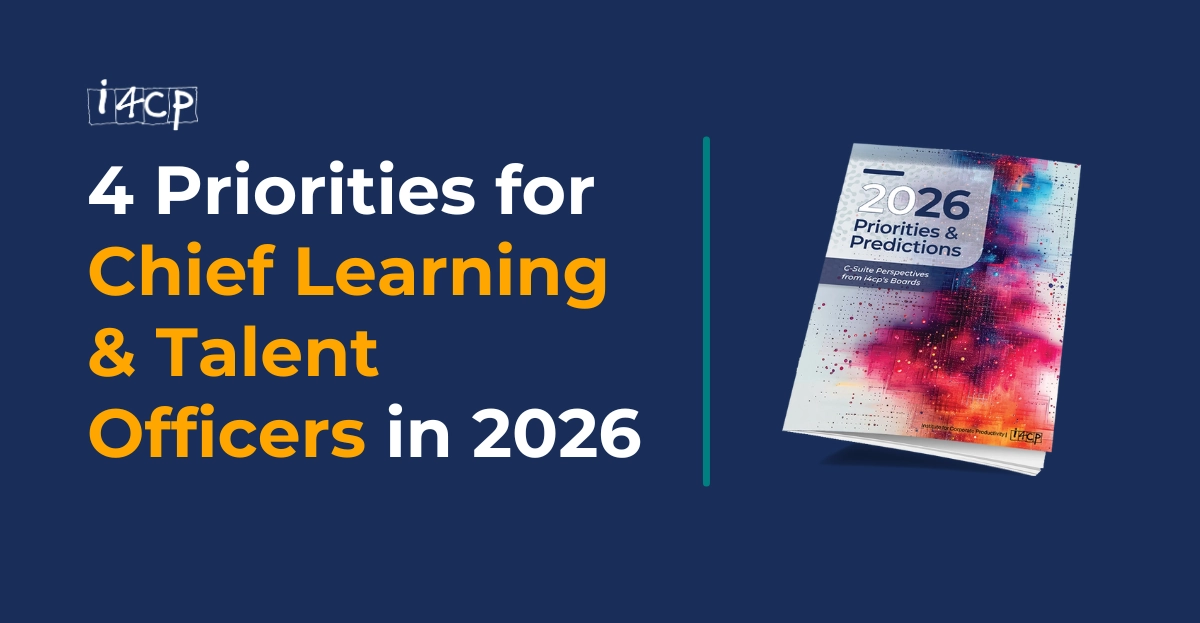
To read the full perspectives of CHROs and senior HR leaders who serve on one of i4cp’s executive Boards, download i4cp's 2026 Priorities & Predictions report.