
Future Ready CHRO Series: How S&P Global’s Girish Ganesan Is Enabling an AI Native Enterprise

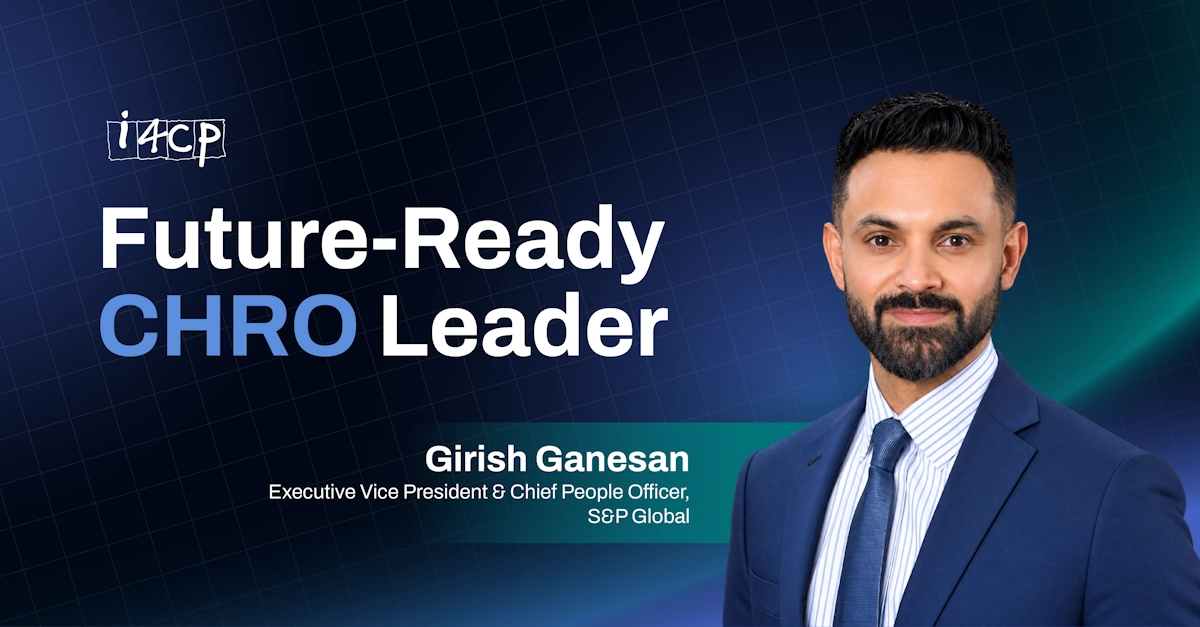
Girish Ganesan is EVP and Chief People Officer at S&P Global, heading up all aspects of HR among other duties. Ganesan is often asked about the future of work, but when he talks about it, he doesn’t start with HR…he starts with the business. And that business, a 40,000‑person organization which operates across 46 countries, is being reshaped by AI from both the outside‑in and the inside‑out.
“We sit at the intersection of data, technology, markets, and deep human expertise,” he recently told i4cp’s Future of Work Board. “AI is not just at the edge of our business. It is changing what our customers expect from us, and it’s changing how we produce what they consume.”
This dual pressure of evolving customer expectations and rapidly advancing internal capabilities has pushed S&P Global into one of the most ambitious organizational renovations underway today, which Ganesan frames as:
- Build the AI‑native enterprise for customers. S&P Global has already launched an S&P Global app inside ChatGPT which leverages adaptive retrieval that allows agents to access S&P Global data via natural language, and redesigned parts of its Market Intelligence business around agentic workflows.
- Build a workforce capable of operating in that environment. “The work ahead is less about deploying tools and more about redesigning workflows, skills, roles, governance, and culture so people and AI can create better outcomes together. That means we start with the workflow, not the technology. We ask where the friction exists, what outcome we're trying to improve, and then determine the right combination of people, processes, data, and AI to achieve it.”
Today’s future-ready leaders understand that it’s not enough to simply adopt AI. To take full advantage, work, workflows, and likely even aspects of the workforce itself need to be rearchitected around it. That shift, from AI adoption to enterprise reinvention, is reflected in four questions that now anchor conversations among Ganesan, CEO Martina Cheung, and the executive team:
Leveraging newfound capacity is something most organizations are only beginning to tackle, but it’s a question Ganesan and others are increasingly exploring.
“Say we redesign a workflow and it takes 30% less effort. You created 30% capacity. The leadership decision is what do you do with it? Grow? Improve service? Redeploy talent? Reduce cost? Build something new?”
It wasn’t too long ago when most companies viewed the workforce as being made up of full-time employees and contractors, but now that view has changed.
“If an agent is doing economically meaningful work, it is productive capacity. So, who owns it? Who governs it? What is the cost? How is performance measured between an agent and a human?”
- Where does AI create enterprise value?
While the company was quick to adopt AI, the conversation is now laser focused on customer value, revenue, cost‑to‑serve, cycle time, and quality.
“We let a thousand flowers bloom,” he said. “Now people want clarity. They want to make impact.”
- Where should human judgment remain in the loop?
S&P Global is decomposing work for various roles including rating analysts, developers, and data operations, to determine:- What requires judgment
- What requires deep domain expertise
- What can be automated
- What is unnecessary
- What happens to the capacity AI creates?
Leveraging newfound capacity is something most organizations are only beginning to tackle, but it’s a question Ganesan and others are increasingly exploring.
“Say we redesign a workflow and it takes 30% less effort. You created 30% capacity. The leadership decision is what do you do with it? Grow? Improve service? Redeploy talent? Reduce cost? Build something new?”
- What is the workforce now?
It wasn’t too long ago when most companies viewed the workforce as being made up of full-time employees and contractors, but now that view has changed.
“If an agent is doing economically meaningful work, it is productive capacity. So, who owns it? Who governs it? What is the cost? How is performance measured between an agent and a human?”
For Ganesan, these aren't simply technology questions. They're questions about how an enterprise creates value, and therefore about the fundamental design of work itself. That puts the CHRO in a very different position than simply leading the people side of an AI transformation. The role increasingly becomes one of helping the organization determine what work should exist, how it should be organized, what capabilities are required, and where humans create the greatest value.
Redesigning Workflows and the HR Operating Model
While S&P Global is redesigning work at scale, most organizations are still scratching the surface. To highlight this, Ganesan shared a striking statistic: 88% of organizations are using AI, but only 6% have redesigned workflows.
S&P Global is in the 6%.
They began with five enterprise workflows that cut across silos and roles which represented about 50% of the workforce. After learning from those pilots, they expanded to nine workflows, now covering approximately 70% of employees. And they are intentionally stopping there for now.
“We’re not going to boil the ocean. These nine workflows get us where we need to be for the next couple of years.”
As part of this redesign, Ganesan added three new capability centers that reflect the demands of an AI‑native enterprise.
- Workforce Planning & Future of Work (a new front‑facing role)
This team owns:- Org effectiveness
- Analytics
- Org design
- Change management
- People data governance
- People Transformation & AI Lead
A dedicated leader responsible for:
- Prioritizing HR use cases
- Building investment cases
- Coordinating with technology, legal, compliance, finance
- Modernizing HR operations (ticketing, call center, processes)
This role was carved out of shared services…someone with in-depth knowledge of the operational reality.
- Culture & Engagement COE
This team is refreshing values, evolving the employee value proposition, and ensuring that human connection remains central. They aim to refine the Company’s corporate values to meet the language of an AI-enabled world, even adding a value to support this evolutionary period.
We want to give people agency,” Ganesan said. “We want you to rethink the work you created a decade ago.”
S&P Global also created a Change Leadership Academy for all 7,000 people leaders, co‑facilitated by Harvard and the company’s top 200 executives. This required learning opportunity is tied directly to business strategy and embedded into performance management. Modules include growth orientation, leading digital transformation, continuous reinvention, creating economic value in human‑agent environments, and leading in AI‑integrated organizations
Ganesan offered 3 pieces of candid advice to peers just beginning their AI journey:
- Don’t wait too long to provide clarity.
Set a clear direction after an initial period of experimentation to sustain engagement and focus efforts.
- Don’t maintain old tools too long.
Retire legacy tools promptly to avoid duplication, confusion, and unnecessary complexity.
- Invest equally in human capability and AI fluency.
“We told people: we’re helping prepare you for an AI-enabled world, not just for S&P Global.”
The CHRO’s New Mandate: Designing the Organization for Reinvention
What makes Girish Ganesan a Future-Ready CHRO isn't simply that he understands AI. It's that he understands what AI makes possible and what it requires organizations to rethink.
At S&P Global, that means redesigning workflows before redesigning jobs, and treating AI agents as part of the productive workforce, not simply as technology. It also means asking what to do with the capacity AI creates, building new capabilities among leaders, and evolving the culture to give employees permission to continuously reinvent the way work gets done.
That may be the most important lesson for CHROs navigating the AI era: the question is no longer how HR should respond to AI. The question is how the organization itself should be redesigned because of it. That is a fundamentally different mandate for the CHRO. It moves the role beyond managing the workforce of today and toward helping shape the organization of tomorrow, determining what work should exist, what capabilities will be needed, where humans and technology create the most value, and how the enterprise can continually adapt as those answers change.
Ganesan isn't preparing the workforce for a future defined by AI. He is helping build an organization capable of reinventing itself again and again, which may be the ultimate definition of being future-ready.