

CEO Led M&A Through the Lens of Culture



How Oregon State Credit Union Reframed Deal Readiness Before the Deal
Snapshot
Organization: Oregon State Credit Union
Industry: Credit union / financial services
Employees: 350
Global Reach: United States
Key Result(s): Gary Schuette II and OSCU’s leadership team elevated culture from a post-close concern to a decisive pre-deal factor, equipping the board with the missing lens it needed to determine not just whether the deal made financial and strategic sense, but whether it could actually succeed in practice.
Introduction
When Oregon State Credit Union (OSCU) began preparing for potential mergers or acquisitions, the work started with a CEO‑led strategic readiness question: How do we make better decisions about a deal before we’re already committed to one?
Gary Schuette II, president and CEO, and the leadership team made a deliberate choice that shaped the entire effort: culture would not be treated as a downstream integration issue. It would be addressed before a letter of intent—while strategic options were still open, risks could still be mitigated, and leadership could make better‑informed judgments about whether a potential deal would work in practice.
“Culture is my #1 priority: to protect and enrich it. If that’s true, then at OSCU, we have to approach things differently including by making culture a core part of any M&A conversations.” - Schuette
This approach reflects a growing body of i4cp research showing that culture change—and, by extension, execution during integration—is most effective when driven by the CEO and examined as rigorously as financial or operational considerations. From this perspective, culture is not a post‑close communications issue. It is an operating system that shapes how decisions are made, how work moves, and how quickly organizations adapt once a deal begins.
The question, then, is not simply whether a deal looks attractive on paper, but whether the combined organization can execute when it matters most.
The Challenge
Like many organizations exploring M&A, OSCU faced a familiar challenge: culture was widely acknowledged as important, but it was typically addressed late in the process—after strategic direction was set and transaction momentum made course correction difficult.
Leadership wanted a clearer, earlier view of risk and fit—a way to understand not just values alignment, but whether ways of working, decision‑making norms, and execution discipline would support or undermine success if a transaction moved forward.
The challenge was how to treat culture as a legitimate form of diligence—one that could meaningfully inform whether a deal should proceed, not simply how it should be integrated.
The Solution Roadmap
i4cp’s approach with OSCU was grounded in its long standing research on culture change, including multi‑year studies across thousands of organizations that identified critical leadership actions required to sustain culture change. Culture Renovation® consistently shows that culture change must be CEO‑driven to meaningfully shape strategy, execution, and decision‑making.
That same lens was applied to the M&A context. Culture was not treated as a values statement or a post‑close communications issue. Instead, it was framed as an operating system, expressed through leadership behavior, decision‑making norms, collaboration patterns, process discipline, and employee experience.
Rather than waiting for a deal to trigger culture work, OSCU chose to establish a clear baseline before any transaction discussions formally began.
Establishing a Cultural Baseline
The work began with a culture assessment using i4cp’s proprietary Healthy Culture IndexTM (HCI) to establish a baseline view of Oregon State Credit Union’s current culture, including cultural strengths and weaknesses.
“At OSCU, we value our rich culture. Taking the time to clearly define it ensures we know exactly what we want to preserve and carry forward as we enter a merger or acquisition.” - Paige Jackson; Senior Vice President, Human Resources
Several strengths emerged clearly: a strong culture identity grounded in member focus and cooperative values, high levels of trust and engagement, and consistent strengths in collaboration, learning, and performance orientation across departments and tenure groups.
Rather than treating these findings as abstract cultural attributes, leadership viewed them as indicators of how work currently gets done—and which elements would be important to protect in any future integration scenario.
How Work Gets Done: Ways of Working
In addition to the Healthy Culture IndexTM assessment, Oregon State Credit Union and i4cp conducted a Ways of Working assessment measuring 15 dimensions of how work happens day to day—including decision-making, collaboration, process maturity, data use, technology adoption, and workload.
With 115 of 133 invited employees responding, the assessment provided a highly representative view across functions, tenure, and job levels. This allowed leadership to look beyond averages and understand where experiences of execution were consistent—and where they varied in meaningful ways.
Leadership and Transparency
Several practices emerged as stable strengths forming a strong operating foundation:
- Member focus and customer orientation
- Collaboration and cross‑functional coordination
- Learning and talent development
- Performance orientation and goal setting
In an M&A context, these practices were viewed as potential accelerators of integration rather than sources of risk.
The assessment also surfaced execution‑oriented practices that represented opportunities to strengthen readiness:
- Decision‑making speed and follow‑through
- Process maturity and standardization
- Use of data and analytics
- Technology adoption and digital fluency
- Workload and pace
“At OSCU, we welcome opportunities to better understand our organization and intentionally strengthen where it matters most. This work not only sharpens who we are but also guides how we evaluate potential merger and acquisition partners—helping us identify where their strengths can complement and elevate our own.” -Jackson
Importantly, these practices showed meaningful variation by role level. Managers generally reported more positive experiences than individual contributors, while executive leadership responses reflected a wide range of perspectives on execution‑focused dimensions. Leadership interpreted these differences as signals of where clearer expectations, greater alignment, or more consistent operating discipline could strengthen performance—particularly during periods of change.
The Result
In an M&A context, these findings helped leadership distinguish between cultural and operational strengths that could accelerate integration and execution practices that might require earlier attention.
Strong member focus, collaboration, learning, and performance orientation provided a stable foundation for bringing organizations together. At the same time, opportunities to strengthen decision‑making, process consistency, data use, technology adoption, and workload management became especially important during integration, when speed, clarity, and consistency tend to matter most.
“The findings improve our odds of success. We can pinpoint the areas of natural compatibility that will provide foundational sources of trust. And, at the same time, we can pinpoint the areas where we need to spend more time building alignment and clarity.” -Schuette
Reframing the Board Conversation
These insights were synthesized into a board‑level briefing focused on cultural readiness and due diligence preparedness. What made the discussion notable was not only the content, but the frame: culture was not presented as a softer people topic alongside the deal. It was treated as core strategic work led from the top. The strategy and data led to complete alignment between the board and executive team, that all future M&A transactions should include a culture assessment as part of the due diligence process.
Ultimately, we agreed that culture is core to it all. We should bring the rigor that we expect in financial performance and systems performance to our culture. Culture is the hard stuff.” -Schuette
Board members drew on their own M&A experience, connecting the findings to real situations where culture and ways of working either enabled success or quietly undermined it. As Paige Jackson, senior vice president of human resources at Oregon State Credit Union, reflected afterward:
“The feedback from the board and Gary was fantastic. The realization and experiential stories coming up from board members to share with Gary were really valuable for both of them. Lots of comments that this is the real work and the most important work around an M&A to get right, and some comfort that we are approaching it differently than other credit unions.”
How to Replicate Success
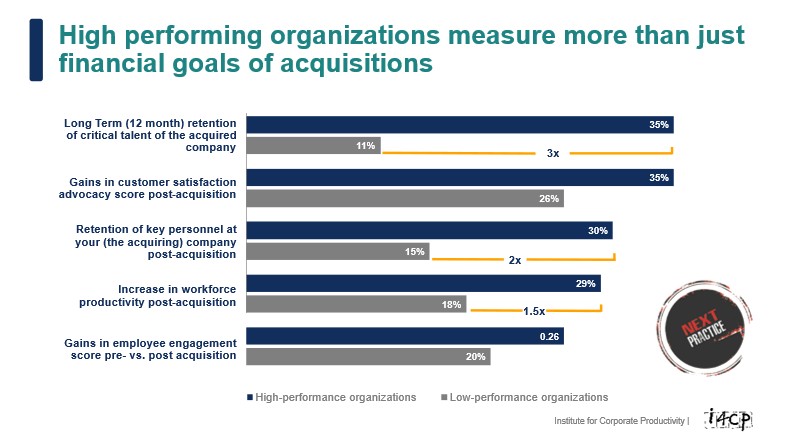
Oregon State Credit Union’s experience illustrates a broader lesson from i4cp’s research: CEOs and boards should think differently about M&A by treating culture as part of pre-deal diligence, not as a post-deal integration exercise.
Culture is not a soft variable. It is the operating system that determines how quickly decisions are made, how effectively leaders align, and whether value is protected or eroded during integration.
“Culture has an outsized impact on performance, which is true on both the downside and upside. I recommend getting culture on your radar in the M&A process as early as possible because otherwise, you’re not seeing the full picture.” -Schuette
By addressing culture and ways of working before the deal, Oregon State Credit Union positions itself with clearer risk visibility, a stronger leadership language for evaluating fit, and board-level confidence that all risks are being identified and mitigation strategies are being developed.
The case suggests a practical shift for CEOs: if culture determines whether strategy can be executed, then cultural diligence belongs at the front end of M&A decision-making, where it can shape judgment, strengthen readiness, and reduce the risk of discovering too late that the deal will be harder to execute than it appeared.
The question is not whether culture will affect your deal. It will. The question is whether you addressed it in time to matter.