Onboard an AI Agent Like an Intern


Successful AI adoption requires the same fundamentals as successful hiring: accountability, clear roles, and ongoing management. Like any new team member, AI agents need structure and oversight. When organizations treat AI adoption like a software rollout, they’re more likely to fail.
We recommend treating AI agents like interns to help leaders understand how to avoid many of the common root causes of AI project failures.
Here are four stages of onboarding your new AI agent as you would a coworker. At each stage, we’ve identified the key checks and conversations that help your “intern” ramp up safely and deliver consistent value.
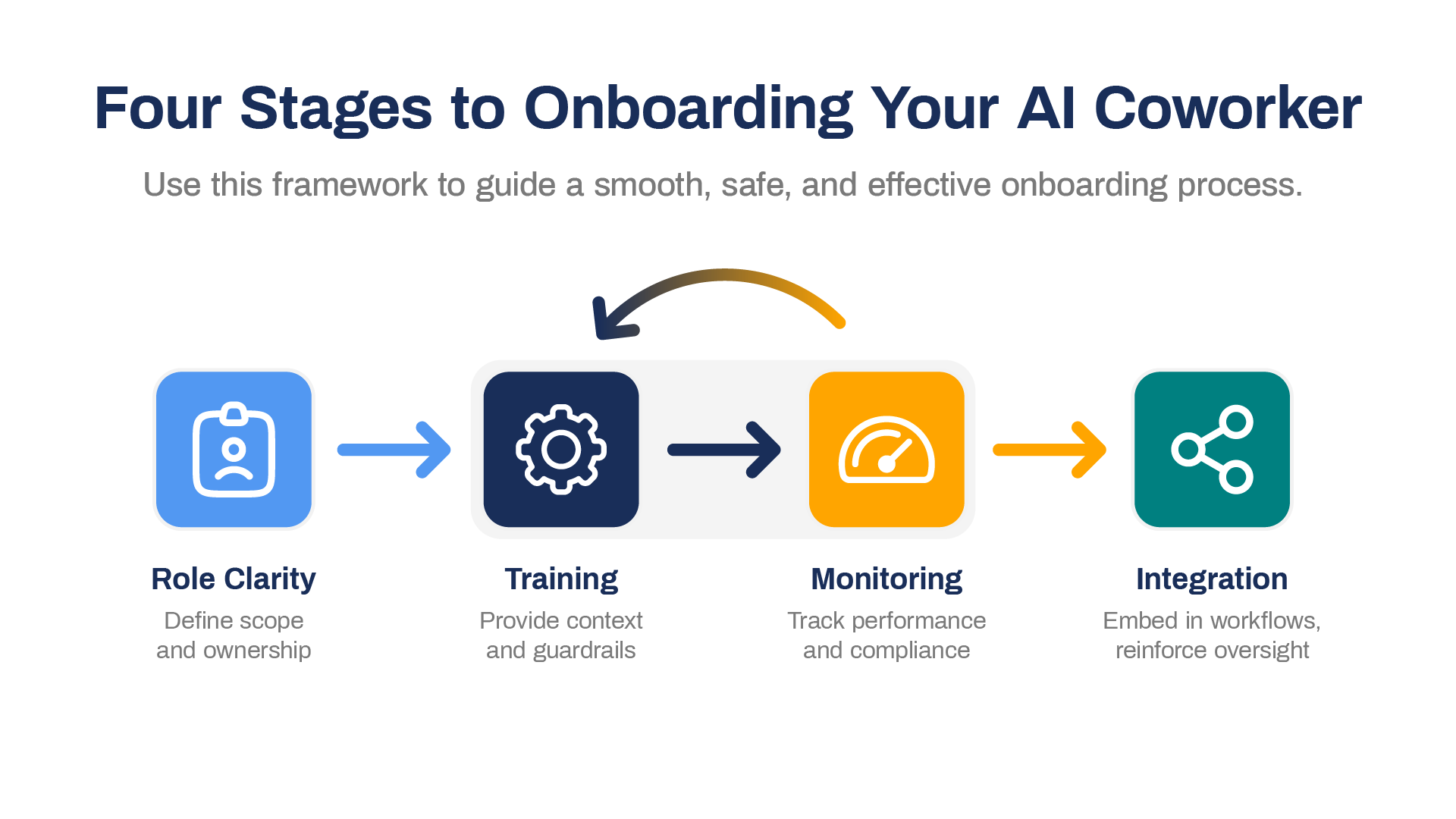
1. Role Clarity
- Define its purpose: Specify what the AI agent will do, its limits, and when human review is required—similar to creating a job description. Identify what data the AI needs. Poor data quality and unclear goals are major causes of failure.
- Assign accountability: A human owner must be responsible for the AI’s performance, updates, and compliance. Identify the agent’s team (other agents and humans).
- Access and permissions: Like interns, AI agents should begin with limited access. Expand privileges only as needed, with proper governance.
- Environment setup: Confirm secure hosting, authentication, and audit logging—akin to preparing a workstation for a new employee.

2. Training (Configuration)
- Context and knowledge: Educate the AI with essential documents—guidelines, policies, tone guides—to align behavior. Poor or biased data can lead to flawed outputs.
- Connect systems: Link the AI to approved tools (CRM, HRIS) and test interactions with humans to ensure smooth handoffs.
- Guardrails and compliance: Set up content filters, rate limits, and restrictions to ensure safe, compliant behavior.
3. Monitoring
- Performance tracking and feedback: Measure accuracy, task completion, and escalation rates—your AI's performance metrics. Like interns, agents need iterative feedback to improve.
- Risk management: Use logs and user feedback to catch and correct errors—similar to coaching an employee.
- Governance reviews: Regularly reassess access, permissions, and compliance to ensure safety.
- Scaling and replication: When an agent performs well, document the setup so others can replicate it in similar workflows.
4. Integration
Successful AI adoption depends on user acceptance. Human teammates must understand the AI agent’s capabilities, limitations, escalation paths, and how to work with it effectively. Address concerns early by positioning AI as augmentation, not replacement.
Reminder: AI agents evolve. What works at launch may drift. Schedule quarterly reviews of performance, permissions, and training data to ensure agents continue to operate as intended.
Ongoing Management
Accountability doesn’t end at launch. Every agent should have a manager responsible for its outcomes, operations, and adherence to boundaries and ethical standards.
Onboarding an AI agent requires clarity, control, and governance. HR plays a vital role in ensuring AI systems remain accountable and safely managed.

Related Content
-
i4cp. (2025) i4cp's Point of View on Agentic AI
-
i4cp. (2026) 2026 Priorities & Predications
References
- RAND Corporation. (2024). The Root Causes of Failure for Artificial Intelligence Projects and How They Can Succeed: Avoiding the Anti-Patterns of AI
- Amazon Web Services. (2025). Automate tasks in your application using AI agents
- Google Cloud. (2025). Use AI securely and responsibly
- Meta AI. (2025). Llama Responsible Use Guide
- OpenAI. (2025). Agents – OpenAI API Guides