

How Delta Air Lines Designed a Total Rewards Statement That Elevates Pay Literacy and Reimagines its Employee Value Proposition



Most employees know amount that hits their bank account following each pay period—but few understand the full value of what their employer invests in them. Delta Air Lines is closing that gap with a refreshed total rewards portal and statement designed to make compensation, benefits, and incentives easier to understand and harder to overlook.
The move has not only promoted pay literacy among employees, but it has functioned as a way for leaders to better communicate the true value of Delta Air Line’s benefits and ward off competing offers in the highly competitive airline industry.
Kathryn Neidhardt, general manager of total rewards at Delta Air Lines, sat down with The Institute for Corporate Productivity (i4cp) to discuss why the airline launched a new total rewards portal and statement for its over 100,000 employees.
How Do We Make Total Rewards More Transparent?
When Delta Air Lines began exploring the prospect of launching a new Total Rewards portal that housed employees’ statements, the team quickly realized that most available solutions weren’t designed for their varied workforce.
“All the examples we’d seen were really geared toward corporate salaried employees,” said Neidhardt. “But the majority of our population is hourly, and their schedules can vary month-to-month. We needed something that reflected their reality.”
Delta Air Line’s diverse array of frontline roles, which range from flight attendants to customer service agents, introduce unique pay complexities. There are premiums for specific work, shift differentials, lead pay, incentive categories for flight crews, and much more when it comes to pay variables. Even well-designed vendor templates struggled to capture that variability in a way that was both accurate and intuitive.
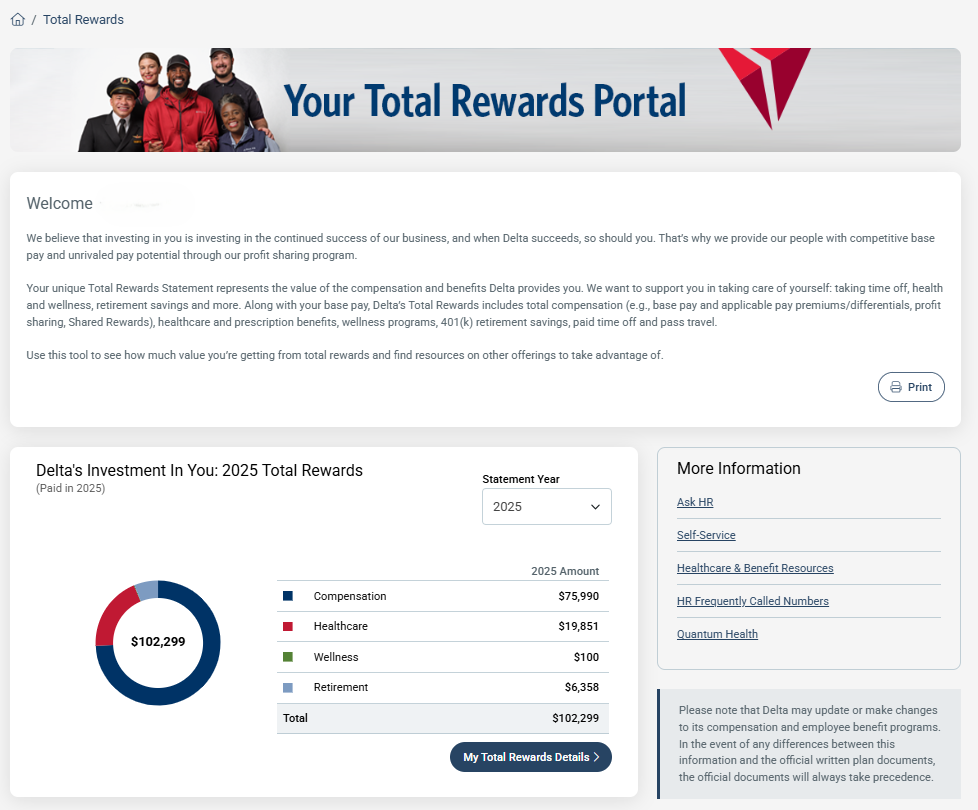 It quickly became clear that the total rewards team would need to build their own platform.
“No one’s been able to create a perfect silver bullet,” Neidhardt said. “But we knew we had to start somewhere—and we started with our frontline employees in mind.”
For frontline-heavy employers, communicating the full value of compensation and benefits has long been a challenge. Hourly schedules fluctuate, pay structures are complex, and many employees simply don’t see—let alone understand—the enterprise investment behind their rewards package.
Making the Full Value Visible—for the First Time
One of Delta’s core goals was to help employees see the total picture of their compensation and benefits—not just base pay, but the rich ecosystem of rewards that their company uniquely touts.
“We get a lot of questions at town halls about base pay,” Neidhardt said. “But employees also earn premiums, and they have benefits that are incredibly valuable. We wanted everything in one place because people weren’t seeing the full picture.”
Two of Delta’s most valuable benefits that leaders wanted employees to better understand were its flight privileges and 401(k) program offered to all employees at all levels. Neidhardt said that these benefits alone are why some employees seek to work or stay at the company. Adding these items into a comprehensive total rewards statement has helped employees better understand how they translate into total compensation.
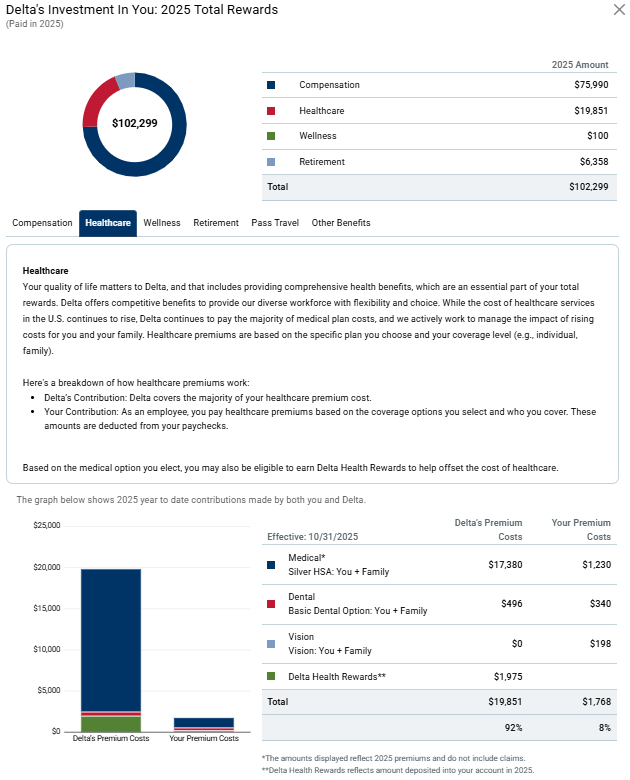 One of the most striking features of Delta’s statement is the transparent breakdown of healthcare costs, showing the portion paid by the employee and the substantially larger portion absorbed by the company. The employer versus employee breakdown has been instrumental in providing clarity and transparency in a time when healthcare costs are skyrocketing in the U.S.
Neidhardt said this was an intentional design choice, grounded in the belief that most employees underestimate the total cost of employer-sponsored health insurance.
“Healthcare is expensive and Delta is covering a very large portion of it,” Neidhardt said. “Seeing that number is eye-opening for a lot of people—especially when they compare it to friends who work elsewhere.”
In many cases, Delta covers upwards of 90% of healthcare premiums, a figure that can reshape employees’ understanding of the value they receive from the company.
Solving for Pay Literacy Through Design
Delta’s team also intentionally avoided using annualized pay projections, knowing they could unintentionally create confusion or unrealistic expectations among hourly workers. Instead, the total rewards statement reflects actual earnings and helps frontline employees decode their pay in ways that resonate.
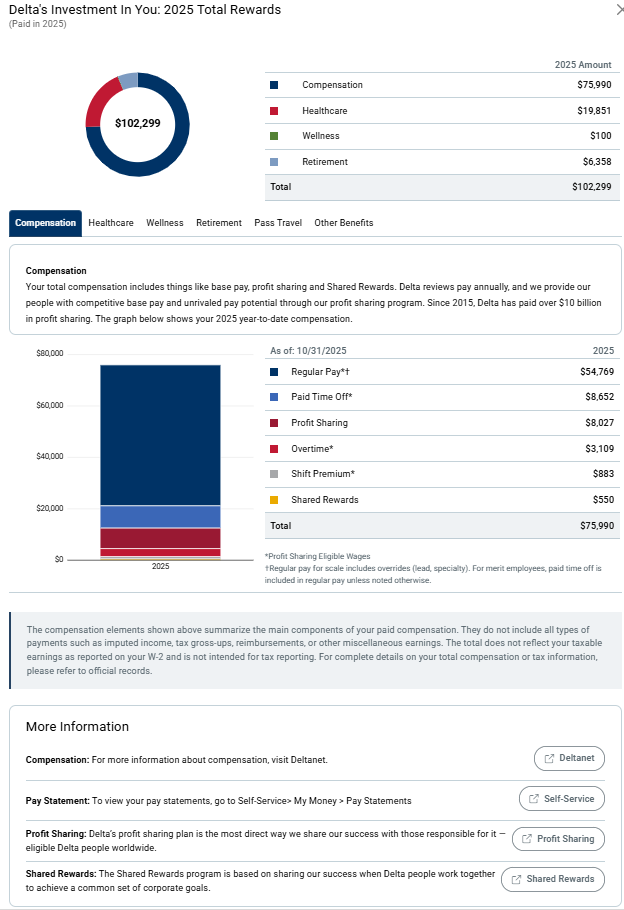 For flight attendants whose pay can include more than a dozen categories and vary month-to-month depending on time spent working, the statement provides a bridge between a traditionally dense pay stub and overly technical flight pay systems. “I often tell people, this is really a visualization of your pay stub,” Neidhardt explained. “Most people don’t look at that every payday, but this makes it easier to understand.”
The Results
Six months after launch, more than about a quarter of eligible employees have accessed their Total Rewards statement via the portal—a meaningful adoption rate according to Neidhardt given the frontline nature of the workforce and the fact that many employees are not consistently plugged into corporate digital channels or in front of a computer during the day.
Communication and enablement of the total rewards portal have largely relied on a mix of QR codes, internal newsletters, and placement in high-traffic digital environments such as the portal used for open enrollment. Yet Neidhardt acknowledged a challenge familiar to many HR leaders across industries: “Some of our population is very unplugged. They’re not checking corporate email every day. We’ve got to continue finding new ways to get in front of them.”
Currently, pilots and executives at the general manager level and above are the only groups that do not have access to the total rewards statement portal due to the more complex nature of their compensation.
The Next Frontier: A Single Digital Hub
While the Total Rewards statement is already elevating pay literacy, Delta’s long-term vision is even more transformative. The team is exploring a consolidated digital experience that would integrate pay information, benefits, and an AI-enabled assistant for real-time questions.
“If we can get everyone to come to the same place—where they automatically know they’ll get their answers—that will be a game changer,” said Neidhardt.
Lessons for Total Rewards Leaders
Delta’s experience offers three insights for organizations considering their own statements:
- Design with your largest workforce segment in mind—not only salaried staff.
- Transparency builds credibility, especially when showing employer contributions employees rarely see.
- Start before the solution is perfect. Iteration matters more than initial completeness.
As Neidhardt put it, “We knew we had to start somewhere—and making the full value visible helps people think twice before walking away.”