
Will AI replace HR? The data says that’s the wrong question.

New i4cp research shows HR headcount is holding steady, but the work underneath it is transforming fast. Organizations pulling ahead are redeploying talent rather than cutting it.
Despite widespread predictions that AI will eliminate large segments of HR, the data tells a different story. According to new research from the Institute for Corporate Productivity (i4cp), 57% of organizations have made no change to HR headcount in the past 12 months. Across HR overall, more organizations are increasing staffing than decreasing it. The myth that AI will replace functions within HR has yet to materialize.
What the data does show is a quieter and more consequential pattern: Inside those flat headcount numbers, the work itself is being redesigned. And whether that redesign happens matters to the business. i4cp found that leaving HR roles unchanged is negatively correlated with both future readiness and market performance. Organizations that leave HRBPs, shared services, and COEs largely unchanged are less likely to be future ready, and deliver the strategic insight, decision support, and more personalized services that the business now demands.
For CHROs, the question is not whether AI will reduce HR headcount. It is whether HR is doing the right work as business expectations continue to evolve and climb.
What the headcount data actually shows
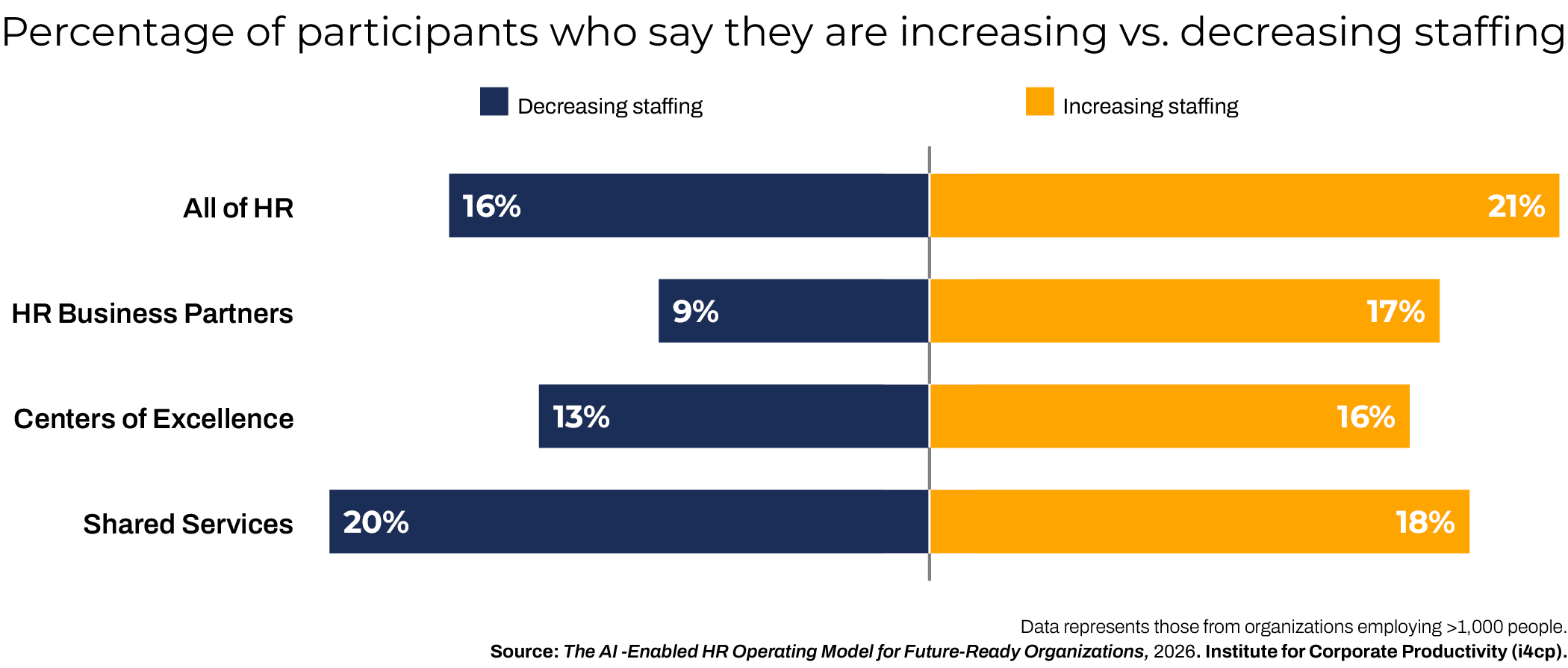
The role-level numbers reveal where the movement is:
- Among HR business partners, 17% of organizations are increasing staffing, while 9% are decreasing.
- Among Centers of Excellence, 16% are increasing staffing, while 13% are decreasing.
- Shared Services are the only role where staffing cuts outnumber additions: 20% decreasing vs. 18% increasing. Though, those from future-ready organizations were twice as likely to report that their HR functions are increasing shared services staffing.
The HR headcount findings come from i4cp’s global survey of 1,338 business and HR leaders, focused on organizations with more than 1,000 employees. The numbers undercut some of the loudest narratives about the future relationship between AI and HR, and they deserve a careful read: HR teams are being asked to do more, deliver it faster, and ground it in better data, often with exactly the same number of people.
Why future-ready organizations are adding shared services staff
Shared services is the one area of HR where more organizations are cutting than adding staffing, and the pull toward AI-powered self-service explains some of that. But, as noted above, the more revealing number sits underneath it: Future-ready organizations — those rating highest on i4cp's three dimensions of AI readiness, skills readiness, and culture readiness — are twice as likely to be increasing shared services staffing (35% vs. 16%).
Why would the organizations furthest along the AI maturity curve be growing the function that AI is supposedly automating away? It’s likely because they’ve repositioned it. In future-ready organizations, shared services operates as the delivery engine for AI-enabled HR. The survey shows their shared services teams concentrating on higher-value work: driving adoption of AI-enabled self-service tools (42%), maintaining HR knowledge bases and the AI models behind them (32%), and converting HR service and workforce data into insights and recommendations (32%). In these organizations, shared services are being rebuilt around the AI to better distribute value.
Redeployment is the real story
The pattern of flat HR headcount paired with the changing work of HR shows up across the function. i4cp’s data reveals where the reclaimed time is going. In future-ready organizations, AI is significantly increasing the time HR spends analyzing data for insights (52%), advising on strategy (47%) and quality-controlling AI outputs (38%). The least future-ready organizations report time shifts at a fraction of those rates; for strategy advising and quality control, roughly a third or less.
Allianz Life has gone further than most in making this systematic. The multinational financial services firm added a sixth “B” — bots — to its long-standing 5Bs strategic workforce planning framework: buy, build, borrow, bind and bounce. AI now appears in every job description, and AI upskilling is embedded in employees’ goals and performance reviews.
“We do not want to get to the bounce B, and if we do, shame on us,” said Bill Ryan, vice president of people and culture and head of learning and development, “because we should have already forecasted that, and we should have, in the build B, been reskilling and upskilling that talent before it got to the redundancy standpoint.”
Ryan’s standard treats reskilling as a forecasting obligation: Anticipate which roles AI will displace, and build the new capability before the redundancy conversation ever starts.
How should HR leaders respond to AI’s impact on HR jobs?
HR leaders should respond to AI’s potential impact on the function not by protecting headcount, but by redesigning what the headcount does. The research points to three moves that separate organizations redeploying talent from those simply holding steady:
- Redesign HR roles around judgment work, not transactions. i4cp recommends rebuilding HRBPs as strategic advisers, shared services as an employee experience and service intelligence hub, and centers of excellence as product and platform owners.
- Reskill and redeploy talent ahead of displacement, not in response to it. Following the Allianz model, forecast which roles AI will change and build the new capability before the redundancy conversation ever starts.
- Assess your own function first. Demonstrated personal and functional AI readiness is HR’s entry ticket to influencing enterprise AI decisions.
Organizations that redesign HR roles, reskill ahead of displacement and assess HR’s own AI readiness are already redeploying talent into higher-value work. The ones still debating whether AI will replace HR are holding the same headcount and yesterday’s work. Those unwilling to reexamine and shift roles within HR will be stuck doing yesterday’s work.
See how future-ready organizations are redesigning HRBPs, centers of excellence and shared services for AI-enabled work in i4cp’s new report, The AI-Enabled HR Operating Model for Future-Ready Organizations. For organizations that are not yet enterprise-wide members, an executive brief is available for download.