

Levi Strauss’ Future-Ready CHRO: Why the Seams Matter More Than the Boxes

As part of i4cp’s commitment to helping organizations become future-ready, we’re continuing our series on Future-Ready CHROs…leaders who are deliberately reshaping their organizations to thrive amid constant change.
Few moments have presented a bigger opportunity for HR leaders to demonstrate their strategic value than the rapid emergence of artificial intelligence. But while much of the conversation has focused on which jobs AI will replace, or which skills employees will need, or what tasks will be automated, Bernard Bedon is looking at the challenge from a different angle.
As Senior Vice President and Chief Human Resources Officer of Levi Strauss & Co., Bedon believes the real opportunity is to rethink how work gets done, and to understand what happens to the broader organization when individual pieces of work change. That means looking beyond jobs and even beyond processes.
Bedon’s perspective has been shaped by roughly 30 years in HR, including experience across consulting, pharmaceuticals, media, biotechnology, and retail. Across those industries, he has seen the HR function evolve considerably.
Early in his career, much of the focus was on stewarding programs and creating the right employee experience. Over time, that shifted toward a much more explicit focus on enterprise performance. That requires HR leaders to understand the business strategy, translate it into the talent and leadership implications, understand how the operating model needs to change, and determine what kind of culture is required for the organization to perform.
However, Bedon believes HR should not assume responsibility for making the entire system work. Instead, leaders have to own it.
That is a significant shift in mindset for HR: from being the function that carries the people agenda to being the function that helps leaders make better decisions about people, work, organization, and performance. The distinction becomes even more important in the age of AI.
The “Super Bowl” moment for HR
Bedon describes joining Levi Strauss & Co. at this point in its history as feeling a bit like the “Super Bowl for HR people.” A tad ironic, since the most recent Super Bowl was hosted at Levi’s® Stadium.
Levi Strauss & Co. is a company that’s 173 years old, with one of the most iconic brands in the world. It has a rich history, deep values, and a strong cultural heritage. At the same time, it is evolving its business, which includes greater emphasis on direct-to-consumer growth while continuing to operate its wholesale business.
The combination of a deep heritage and significant change is precisely what makes the current moment so pivotal for HR.
AI is accelerating the transformation of work across virtually every part of the enterprise, and for Bedon, that creates an unusual opportunity. Historically, HR leaders have often had to persuade business leaders to pay attention to the people implications of major changes. Now, the business itself is coming to HR asking for help.
“The disruption came to us,” Bedon observed.
His goal is to take advantage of that moment, and not simply to respond to disruption, but use it to create greater organizational impact and future-readiness.
Bedon described that Levi Strauss & Co.’s focus for AI initially was similar to most organizations: as a potential means of increasing efficiency, reducing work, and lowering costs. Bedon helped broaden the conversation to include the implications for the workforce and organization and to shift the focus on how to leverage AI to perform differently.
While the business owns outcomes and workflows, and technology owns the tools and architecture, HR is now helping to shape the operating model, roles, skills, leadership, and change required to make the transformation work.
Leveraging i4cp’s Workflow Mapping Assistant
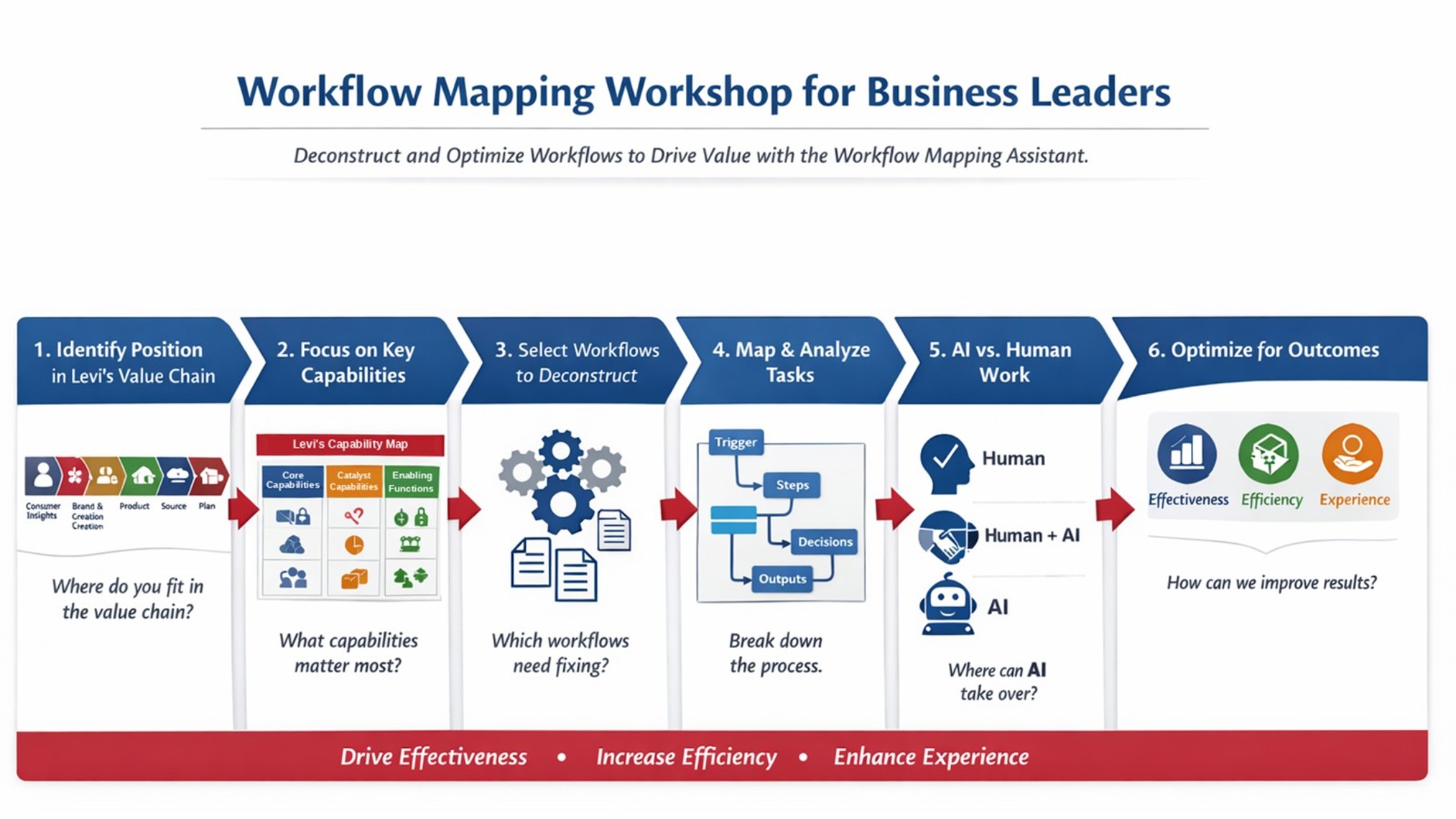
One of the most practical examples of this philosophy came through Levi Strauss & Co.’s use of i4cp’s Workflow Mapping Assistant. The team began by deconstructing work within HR, starting with executive recruiting.
The team mapped the current process, examining the outcome it was intended to produce, the decisions involved, roles, handoffs, and pain points. They also examined what unnecessary work could be eliminated, where human judgment and relationships remained essential, and who should own which decisions. Then the team introduced AI into the workflow, and the difference was dramatic.
What had previously taken several hours could now be completed in minutes. A subject-matter expert could work with the tool, validate the output, and rapidly map multiple processes rather than spending hours manually documenting.
The value, however, wasn’t just an increase in speed. It was also the way it connected work analysis to the broader organizational system. A process change inevitably raises questions about strategy, people, leadership, rewards, structure, and culture. Those connections are where HR’s organizational-development expertise becomes particularly valuable.
The ultimate objective isn't to create an organization with fewer humans. It is to create a better organization in which humans and technology perform the work each is best suited to perform. For Levi Strauss & Co., the company's values—originality, empathy, performance, integrity, and courage—became critical cornerstones for this process. As the organization redesigns work, Bedon continues to examine “Have we kept the soul of who we are?”
Similar to the premise behind i4cp’s book Culture Renovation®, the question balances the desire to systematically change with the times while preserving what makes the organization distinctive. For Levi Strauss & Co., that means leveraging technology to improve operations and the experience for consumers, communities, and employees, without losing the essence of a 173-year-old company.
AI will expose the seams
Perhaps Bedon’s most provocative observation is that organizational performance problems rarely sit neatly inside organizational boxes…instead, they occur at the seams.
“Boxes on an org chart rarely cause performance problems,” Bedon explained. “It’s the seams between the boxes that do.”
That appropriate analogy and perspective is helping to shape Levi Strauss & Co.’s approach to what the company describes as a “human-led hybrid workforce” — a workforce in which people and digital agents work together, with humans remaining at the center of the decisions, values, relationships, and experiences that matter most…and operating within the seams.
Consider the connection between design and product development. Designers may be focused on creating a breakthrough consumer experience. Product development may be focused on making something manufacturable, cost-effective, and deliverable on schedule.
“These sides of the seam are usually pursuing some kind of a legitimate but different objective,” Bedon noted.
Bedon articulated an important implication: HR frequently operates in the middle of organizational seams between leaders and employees, between functions, between strategy and execution, and increasingly between humans and technology.
That insight changes the role of HR. Rather than simply helping each function optimize within its own boundaries, HR can help leaders understand what happens across the boundaries. That requires looking at ownership, decision rights, information flows, incentives, and the handoffs through which work actually moves.
It also requires helping leaders see the larger outcome they are collectively responsible for. Without agreement about the desired outcome, teams can easily optimize one part of the system while making the overall system worse.
For a future-ready CHRO, therefore, the work is not simply to identify opportunities to use AI. It is to help the organization become clearer about what it is trying to accomplish and then redesign the work and organization accordingly.
Bedon believes AI will make these “organizational seams” even more visible. An organization might successfully use AI to augment a task or eliminate a step in a process. But that does not necessarily mean improvement; the work has to be put back into the larger workflow.
That is why Bedon sees organizational deconstruction not as a way to eliminate seams, but as a way to make them visible, with as little friction as possible.
“There’s going to be some friction,” Bedon acknowledged. “But how can you minimize and then find your way through it?"
Building future-ready capability inside HR
Levi Strauss & Co. is now looking to make this way of working more systematic. Bedon expects more of the work to continue into 2027, with the goal of linking the process more fully into the organization's broader systems.
That includes building fluency within HR around organizational-development systems thinking and training functional experts in the business to work alongside HR.
The future-ready HR professional, in Bedon’s view, needs both analytical and relationship skills. There is a temptation to think that becoming future-ready requires HR leaders to master every new technology, methodology, and emerging discipline. Instead, the core skills and methodologies of HR remain highly relevant. AI is another powerful force that needs to be integrated into that existing body of work.
For the future-ready CHRO, it is also an organizational transformation, and perhaps an unprecedented opportunity to demonstrate the value of HR as an enterprise function.