

Cummins’ Intentional Culture: Five Actions for Turning Culture into a Competitive Advantage

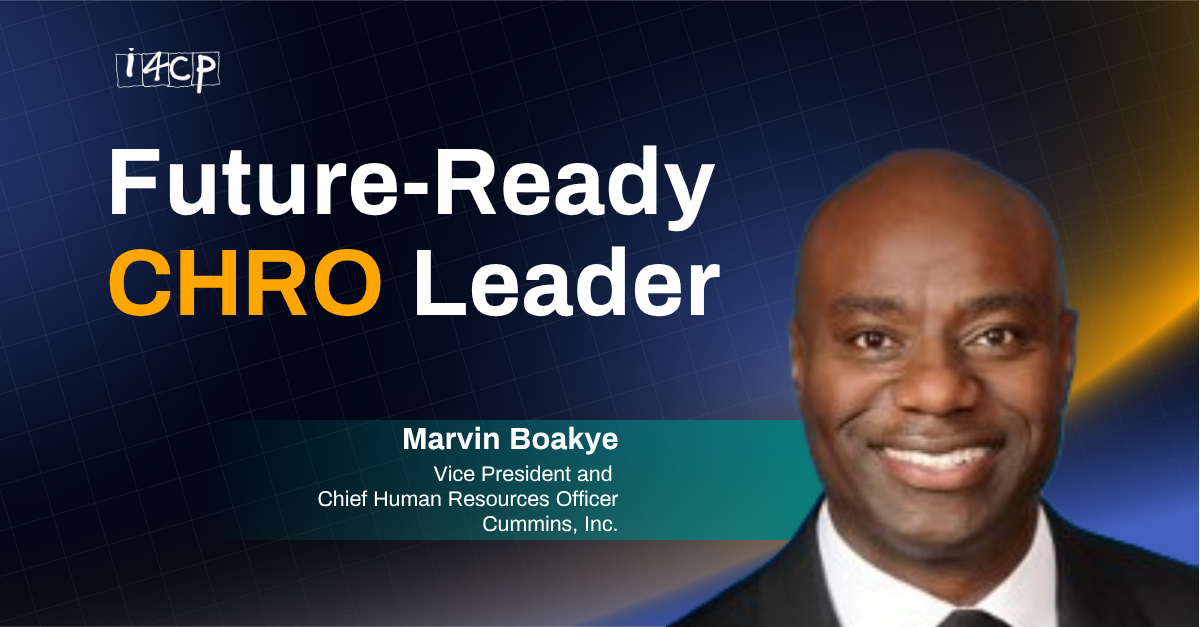
As part of i4cp’s commitment to helping organizations become future-ready, we’re continuing our series on Future-Ready CHROs…leaders who are deliberately shaping cultures that enable their organizations and people to thrive amid constant change.
Few companies illustrate the importance of culture quite like Cummins, a Fortune 500 company ranked #137 in 2026, with approximately 70,000 employees. Yet “culture” is one of those words that everyone uses, and few people define the same way.
For Marvin Boakye, Chief Human Resources Officer, the definition is refreshingly simple:
“Culture is what you practice, what you promote, and what you permit.”
That definition has become the foundation for a much larger effort at Cummins to make culture more intentional, teachable, and measurable.
The effort is particularly relevant given the evolution that is underway at Cummins. The company has progressed significantly beyond its traditional identity as an engine manufacturer, with employees operating around the world and businesses spanning power generation, transportation, industrial applications, and emerging energy technologies. Its customers increasingly depend on Cummins as a technology and power-infrastructure partner, including amid the rapid growth of data centers and AI.
That kind of evolution puts a premium on organizational adaptability, yet Boakye isn't approaching culture as something that needs to be “fixed.” In fact, it’s quite the opposite.
Cummins has enjoyed a healthy culture for some time, and the company has received significant external recognition for it. The challenge, Boakye believes, is keeping that culture future-ready, and making sure that a strong culture is intentional enough to remain an advantage as the business, and the industries they serve, continue to evolve.
“Every organization has a culture, whether they know it or not,” Boakye recalled a longtime Cummins board member telling him. “Very few organizations have an intentional culture.”
That observation stuck.
“So, we have continued as an organization to say, what does it mean to have an intentional culture?” Boakye said. The answer has evolved into five distinct actions.
1. Create a Clear Set of Values
The first step toward an intentional culture is clarity.
Organizations can have lengthy lists of values, but that doesn't necessarily mean employees understand them or even remember them when they need to make a decision. Cummins has therefore focused on making its values clear enough that they can become part of everyday behavior.
The company's experience has reinforced a basic principle: values cannot simply be words displayed on a wall. They need to provide guidance in the moments when people are actually making decisions, which is particularly important for a company as large and global as Cummins. A cultural framework needs to resonate across geographies, functions, and levels of the organization.
The work is also evolutionary. Cummins is currently preparing for the next evolution of how it talks about its values, building on what it has learned from putting its culture into practice.
That willingness to continually refine the framework is part of what makes the culture intentional. The goal isn't to find the perfect set of values and declare victory. It is to continually ask whether the organization's stated values help people operate and execute effectively, and whether those values remain relevant to where the company is headed.
2. Practice the Behaviors That Make Values Visible
Values tell people what matters, but behaviors show people what that looks like day-to-day. That distinction is central to Cummins' approach.
As the company has worked through its culture, it has translated values into specific behaviors that employees can observe and apply. In some cases, Cummins has gone further by defining different levels of proficiency for specific behaviors depending on the role.
That creates considerably more clarity than simply telling someone to “live the values.”
It is also why Cummins has engaged employees in the process. Boakye said the company solicited feedback from employees to understand what they are learning and experiencing, even though it was understood that leadership would own the culture.
That distinction is important: employee input helps inform the culture, but leaders are responsible for making it real.
3. Lead by Modeling the Culture You Expect
People experience culture through their leaders. Cummins therefore made a deliberate decision that leaders would be the primary models of the culture.
“If you're going to be a leader in Cummins,” Boakye explained, “there's three things that you need to be able to do to demonstrate this culture.”
- Self-awareness
- Authenticity
- Vulnerability
For many leaders, particularly those who grew up in a traditional corporate environment, that can feel like a significant departure from the leadership model they were taught. Boakye included himself in that group.
“We were taught, be tough. Never show emotion,” he said. “Don't admit that you're wrong.”
Cummins is deliberately challenging that notion. Leaders are expected to acknowledge mistakes, talk openly about what they are learning about themselves, and be willing to express uncertainty or even fear.
Boakye recalled being able to tell his leadership team, “We're about to go through something. I'm scared.”
That kind of vulnerability might traditionally have been viewed as a sign of weakness. At Cummins, he says, the opposite has happened.
“When our leaders do that, it actually creates greater relationships and more trust.”
The company began this work with its senior leadership team and then extended it to the next 10,000 people leaders. And there is an important reason for putting leaders at the center: while the business environment continues to evolve, the core of the culture is sustained by what leaders do repeatedly.
4. Develop Yourself So You Can Coach Others
In addition to modeling the culture, Cummins also expects leaders to coach others to represent the culture as well. That requires leaders to continually develop themselves first.
“Developing yourself so that you can coach others” became the fourth action in Cummins' framework.
The development work is highly experiential. Leaders regularly practice self-awareness, authenticity, and vulnerability. They practice giving and receiving feedback. They practice talking about emotions.
For an organization with a strong engineering heritage, that last element might sound unusual. Boakye acknowledges that it can feel foreign.
But Cummins has found that learning to talk about emotions, and then connecting those conversations to the business, can be a powerful differentiator.
“Every time we did that, it continues to increase the level of trust that we have with our team members,” Boakye said.
The point isn't emotional expression for its own sake. It is developing leaders who are sufficiently self-aware to understand their own impact, authentic enough to build trust, and vulnerable enough to create an environment where others can learn, experiment, and grow.
And then teaching them to coach those capabilities in others.
5. Measure Whether Culture Matches Intent
The final action addresses perhaps the biggest weakness in most culture efforts: measurement.
“You needed to treat culture and measure culture in the same way that you measure your finances,” Boakye advised.
Cummins uses engagement surveys to measure specific elements of culture. Leaders conduct listening sessions and “cafés” to understand what employees are experiencing. Leaders are expected to share what they learn back with the organization.
The company's global analytics team has also developed talent-risk analysis using a set of variables that Boakye said is about 90% accurate in identifying patterns associated with employee risk. But perhaps more important than any individual metric is what Cummins has done with accountability.
The company has wrestled with the question of what accountability actually means in the context of culture. After trying different definitions, it has embedded accountability into its evolving values framework.
The executive leadership team now has a set of accountability metrics that are published and reviewed quarterly with the CEO. Those measures encompass business performance, equitable outcomes, and how effectively leaders are delivering on the values and behaviors that matter to Cummins. And the measures cascade.
Boakye receives his own metrics, shares them with his team, and expects his team to make those metrics their own. That is a meaningful shift from treating culture as an engagement score or an HR initiative.
Instead, culture has become part of the operating system.
Culture in the Age of AI
Intentional culture isn't about constantly reinventing the organization. It is about actively renovating the culture by being deliberate about what needs to be preserved, and what needs to evolve as the business environment changes.
The next frontier for Cummins' culture work may be AI.
Boakye believes AI will play a significant role across virtually every part of HR, including talent assessment, development, and employee services. Cummins is already using AI to make it easier for employees to get answers in the language and format they need. But Boakye sees an even more interesting opportunity: teaching AI the culture.
The company is exploring ways to feed its methodologies, onboarding practices, values, and behaviors into AI models. The potential application is powerful.
Imagine a leader asking an AI-enabled coach for advice on a situation and receiving an answer grounded not simply in generic leadership principles, but in Cummins' own values and behaviors. AI could potentially respond with something like: That approach is inconsistent with the values and behaviors you've established.
In that sense, AI could become another mechanism for making culture teachable and scalable. The biggest obstacle isn't necessarily technology. It's adoption.
Employees naturally have concerns about what information they're entering, what happens to it, and how it will be used. Cummins is therefore working to build comfort and confidence with AI as part of its broader development cycles.
That work will also require the very cultural capabilities Cummins has been developing: adaptability, openness, trust, and a willingness to learn.
To be Future-Ready, Working on the Culture is Never-Ending
There is an appealing irony in Cummins' approach.
The company is deliberately trying to make its culture more intentional while simultaneously recognizing that culture can never be completely perfect. It has to continue to evolve.
Boakye describes culture work as a constant journey of learning, adjusting, and adapting. That mindset is particularly important for an organization navigating technological change, energy transition, AI, and new demands from customers and employees. It also explains why Cummins is beginning to think differently about the talent it brings into the organization.
The company has learned that technical competence alone doesn't always predict success for senior external hires. Some highly capable leaders struggled because they found it difficult to adopt Cummins' culture.
In fact, Cummins is increasingly asking:
- How adaptable are you?
- Are you willing to embrace the culture?
- Are you willing to go through a journey that might teach you new things about yourself?
That may ultimately be one of the most important capabilities in an organization that intends to remain future-ready.
Five Lessons for HR Leaders to be “Future-Ready”
Cummins' experience offers a useful roadmap for organizations that want to move culture from aspirational to intentional:
1. Define culture simply.
If employees can't explain what culture means, it is difficult to make it intentional. Cummins' “practice, promote, permit” definition gives leaders a common language.
2. Make values visible through behaviors.
Values become meaningful when employees understand what they look like in practice, and what proficiency looks like in different roles.
3. Put leaders at the center.
Employees experience culture through their leaders. Leaders therefore need to model the culture rather than simply communicate it.
4. Develop leaders so they can coach others.
Culture becomes scalable when leaders can help other people develop the capabilities needed to live the culture.
5. Measure culture against intent.
If culture is a competitive advantage, it should be measured, discussed, and held accountable with the same discipline applied to other aspects of business performance.
Perhaps the biggest lesson from Cummins is that intentional culture isn't about creating a perfect culture. It is about creating enough clarity and discipline to know what the organization stands for, how those principles should show up in behavior, how leaders should model them, how people can develop them, and whether the culture people experience actually matches the culture the organization intends to create.
That is a much higher bar than simply having values on a wall.
And for a company navigating as much change as Cummins, it may also be one of its most important sources of future competitive advantage.