
The Future-Ready CHRO: How Lowe’s Is Helping to Build America’s Future Workforce

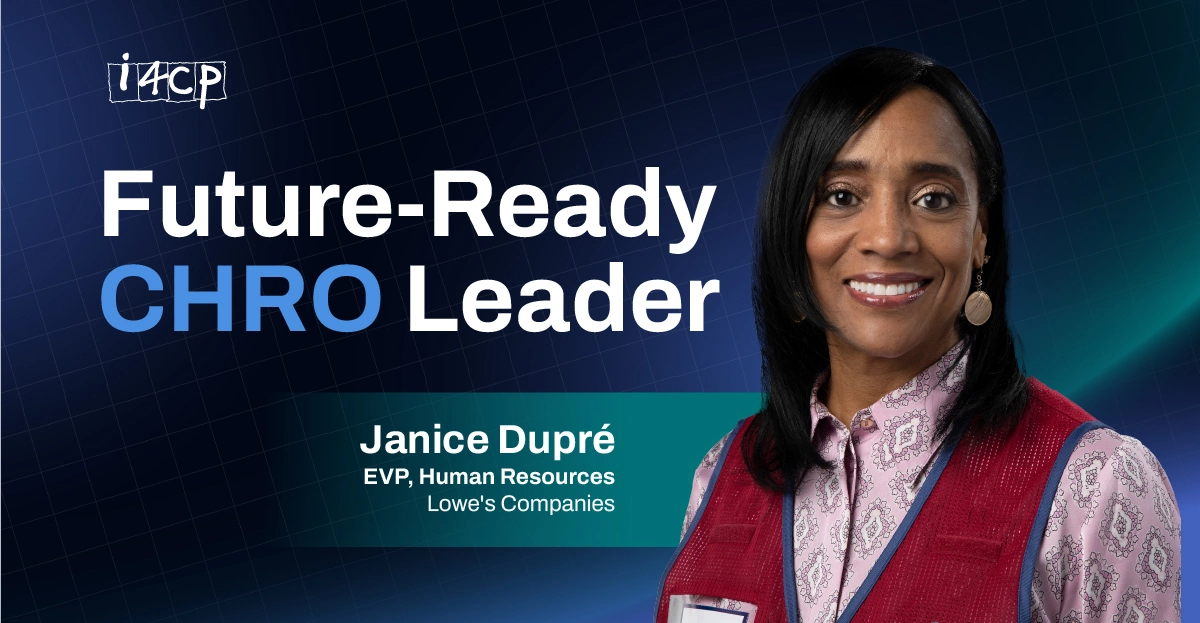
As part of i4cp’s commitment to helping organizations become future-ready, we’re continuing our series on Future-Ready CHROs…leaders who are deliberately reshaping their organizations to thrive amid constant change.
America is faced with a skilled-trades problem.
Across construction, infrastructure, manufacturing, energy, and other industries, demand for skilled workers is growing…while the supply of people entering those careers is not keeping pace. Lowe’s, a FORTUNE® 100 home improvement company with approximately 300,000 associates, estimates that millions of skilled-trades jobs could go unfilled in the coming years.
For many companies, a problem of that magnitude might seem too large to tackle. But for Lowe’s, and their EVP of HR Janice Dupré, it represents precisely the kind of challenge that organizations should be willing to run toward.
“I think one of the things I love about us is that we're never afraid to go after something daunting,” said Dupré, who will be a keynote presenter at i4cp’s Next Practices Now conference at the end of March.
That mindset has helped transform what began as a philanthropic initiative into something much bigger: a long-term effort to rebuild the skilled-trades workforce in America.
In April 2026, the Lowe’s Foundation announced a $250 million commitment to help train and develop 250,000 people for skilled-trades careers by 2035. That expanded commitment builds on the foundation’s original $50 million effort to prepare 50,000 people for careers in the trades. The original program was progressing faster than expected, prompting Lowe’s to dramatically increase its ambition.
And the ambition has continued to grow. In September, the Lowe’s Foundation (of which Dupré is the chair) launched the Building Futures Skilled Trades Coalition, bringing together more than 75 companies, educators, workforce organizations, nonprofits, and industry stakeholders with an even larger goal: collectively helping train and develop one million people for skilled-trades careers by 2035.
While many organizations focus on the “future of work,” there is a certain irony in the current conversation. Most of it is dominated by artificial intelligence, automation, robotics, and digital transformation. Lowe’s is certainly participating in that future, but their work with the coalition highlights another truth: technology won't eliminate the need for plumbers, electricians, carpenters, HVAC technicians, and other skilled professionals. In fact, technological progress is likely to make these workers even more important in the future.
Lowe’s effort represents what a future-focused organization can do when it sees a problem that matters and decides to lead. It also defines the organization’s culture.
“Culture is not something you talk about,” she says. “It's something you have to live and breathe and you have to invest in it and you have to demonstrate action.”
From corporate initiative to workforce movement
When the Lowe’s Foundation began focusing seriously on the skilled trades nearly four years ago, there wasn't an obvious playbook.
“We said, we’re going to be the authority on this work,” Dupré recalls. “We're going to figure it out. There was nobody doing it when we started it.”
The foundation began building a network of partnerships and experimenting with ways to expand access to skilled-trades careers. The Gable Grants program by the Lowe’s Foundation became an important part of that effort, supporting community colleges and nonprofit organizations that recruit, train, and connect people to careers in areas such as construction, carpentry, HVAC, electrical, plumbing, and property maintenance.
Rather than attempting to build a Lowe’s-owned training system, the foundation invested in organizations already embedded in their communities, which is an important distinction.
Lowe’s didn’t embark on this effort just to create a workforce for itself. In fact, Dupré is emphatic that the people supported through the program don't necessarily become Lowe’s employees, or even Lowe’s customers.
“We're not hiring them,” she says. “We're just funding to get them certified because the country needs it.”
Rather than focusing purely on how to locate great talent for their own organization, Lowe’s is focused on a more noble pursuit: how to increase the supply of talent everyone will need in the future.
The CEO gives HR permission to think bigger
Dupré credits Lowe’s chairman and CEO Marvin Ellison with creating the conditions for the initiative to grow.
“He gives you room to dream,” she says.
That permission matters. The initiative has required Dupré to operate outside the traditional boundaries of an HR function focused on workforce issues. She is helping lead a national effort involving CEOs, educators, nonprofits, vendors, community colleges, and workforce organizations.
When Dupré needed CEOs to participate, Ellison was more than willing to open doors. When she wanted major companies to join the effort, he reached out directly. And when the initiative expanded into a national coalition, he remained deeply engaged.
“He's been on every call with these CEOs talking about this coalition,” she said.
The coalition now includes more than 75 founding members, including NVIDIA, AT&T, Bank of America, Carrier, General Motors, DEWALT, and Duke Energy. “No one entity can solve this,” Dupré adds.
“Talk less. Do more.”
There is another element of this endeavor that is particularly revealing. For the first several years, the company didn't talk much about the work externally.
“Talk less, do more,” is Ellison's mantra, according to Dupré.
Lowe’s Foundation simply built the partnerships, funded programs, learned what worked, and expanded the network. Only after the initiative had established some momentum did the company begin telling the story more broadly.
“We just took what we already were doing in the dark and brought it to the light,” Dupré says.
Dupré says the initiative has become an important pillar of how Lowe’s thinks about its brand and its role in communities. But she isn't satisfied solely with the knowledge that the company is doing a good thing for the community… she wants to know whether it is working.
Dupré came to HR through a finance background, and she says that experience has shaped the way she approaches the function.
“Everything to me has to come back to value,” she says.
That means asking hard questions.
Are communities actually better because of the investment? Are people being successfully trained and certified? Are programs producing sustainable careers? Is the initiative reaching its intended outcomes?
“If the foundation can't hit objectives and can't get more people certified in these spaces, then what are we doing?” she asks.
The future-ready CHRO as ecosystem builder
The approach Dupré and Lowe’s have taken provides an important lesson on the evolving role of the CHRO. While the traditional model of HR is largely employee-focused and organization-centric, future-ready CHROs will increasingly think in terms of ecosystems.
Capability building is a central internal element of strategic CHROs, but future-focused HR executives will expand that thinking, and ask what capabilities will our business—and the communities and industries we depend upon—need five, 10, or 15 years from now?
The answer to that question has a few implications. It could mean partnering with colleges and universities, partnering with competitors, collaborating with government, nonprofits, or industry associations. Like Lowe’s, it may even mean investing in people who will never become your employees.
That can feel counterintuitive to a function traditionally focused on organizational talent. But in an increasingly interconnected economy, the boundaries of talent strategy are becoming more blurred. Lowe’s is betting that strengthening the broader talent ecosystem ultimately strengthens everyone.
Including Lowe’s.