

Interested in participating? Contact our team to discuss eligibility.
If you are an i4cp member, please log in to access the registration/meeting details.
Meeting Details
ROUNDTABLE: NEEDS AND LEADS
The meeting started with the traditional round table discussion of “Needs” (areas where members are looking for resources or someone to connect with) and “Leads” (resources or successes that members are open to sharing.)
Common themes of Board member’s needs were:
- Making the AI ROI and business case (especially risk/legal)
- Reinventing performance management
- Executive succession in volatile environments
- Integrating fragmented talent data systems
- Defining leadership in the AI era
- Workforce planning and internal mobility
Members noted that they had success stories and leads they could share that included:
- AI in talent acquisition and career development
- Leadership development innovation (institutes, simulations, frameworks)
- Skills-based and personalized talent systems
- AI agents and workflow augmentation
- Scalable learning ecosystems (in-the-flow-of-work)
- And some book recommendations:
- “Leading with Human Skills” by Nick Van Dam
- “Smart Brevity” by Jim VandeHei, Mike Allen, and Roy Schwartz
- “Hidden Value”, by Keith Keating
We’ve collected the specifics and will be working to help connect members whose needs align with others leads.
TOM STONE RESEARCH REVEALS
Tom Stone’s presentation focused on two recent i4cp studies. The first was a public pulse survey on the impact of AI on early career talent. The second was to report the findings of the recent survey of CLTO Board members regarding the evolving structure of the talent function.
Impact of AI on Early Career Talent
Tom began by sharing results from a pulse survey of HR leaders that explored whether AI was reducing entry-level hiring. Contrary to the prevailing narrative, the data showed that early career hiring had largely remained stable or even increased slightly, with only a minority of organizations reporting declines. He emphasized that where decreases had occurred, they were more often driven by economic factors—such as cost pressures, restructuring, and uncertainty—rather than AI alone. However, organizations were clearly raising the bar for entry-level talent, expecting new hires to arrive with AI skills and to achieve productivity faster.

There was considerable group discussion that followed, and it reinforced and nuanced these findings. Several Board members noted that their organizations were continuing to hire early career talent but were struggling with retention, particularly in the first few years. Others described accelerating development timelines, moving employees to higher productivity or new roles much faster than in the past. One member highlighted a growing imbalance: while technical and AI skills were being emphasized, foundational human skills—such as critical thinking, collaboration, and problem-solving—were at risk of being underdeveloped. Another pointed out that some reductions in hiring were occurring in specific areas, such as contact centers, where AI was automating routine work, though even their organizations were reconsidering how humans could be redeployed into more complex roles.
Tom then noted that the outlook for early career hiring this year was on par with the earlier findings.

Structure of the Talent Function
Tom transitioned to the structure of the talent function, sharing CLTO Board survey data showing that most organizations remained highly centralized, with smaller numbers operating hybrid or federated models. He outlined the benefits of centralization—such as consistency, efficiency, and strategic alignment—as well as the challenges of decentralization, including redundancy and uneven capability.
The group’s discussion revealed a more complex reality. Several Board members described federated models as “messy” but valuable for speed, experimentation, and alignment with business needs. Others explained that their organizations were intentionally balancing local flexibility with global standards, often through governance mechanisms, councils, or shared processes.

Participants also reflected on the ongoing tension between centralization and decentralization. One member observed that over time, organizations had moved toward greater centralization due to cost pressures and the need for consistency. However, a new pattern is emerging: not a return to decentralization, but a “diffusion” of talent capabilities across the organization, enabled by self-service tools and AI. This raised new challenges around governance, alignment, and maintaining a connection to enterprise strategy. Another member suggested reframing governance as “decision frameworks” to make it more accessible and less restrictive, highlighting the importance of language and mindset in driving adoption.
The conversation also highlighted the critical role of HR business partners and co-creation with the business. Several members emphasized that involving HRBPs and business leaders early in designing talent solutions increased ownership and effectiveness. Others described efforts to standardize core processes—such as performance management and succession planning—while allowing flexibility in how they were applied across different business units or regions. There was broad agreement that capability disparities across HR teams remained a significant challenge, particularly in global organizations.
In discussing functional scope, Tom noted that most talent functions continued to focus on traditional areas such as learning and leadership development, performance management, and succession planning. However, participants highlighted emerging shifts, particularly the growing importance of people analytics, organizational design, and workforce planning. Several members described increasing demand for organizational design and operating model work as companies adapted to AI and business transformation. Others emphasized that embedding analytics capabilities within talent teams had significantly improved decision-making and strategic impact.

Finally, Tom touched on AI adoption within talent functions, noting that most organizations were still in an “additive” phase—using AI to enhance existing processes rather than fully transform them. He observed that while some functions or companies were advancing rapidly, adoption remained uneven. The discussion reinforced that organizations were still experimenting with tools, use cases, and governance models, with many recognizing that the real opportunity lay not just in efficiency gains but in fundamentally redesigning work and talent systems.

Tom concluded by highlighting a key tension: while AI and external pressures are accelerating change, most organizations are still in transition—rethinking talent strategies, experimenting with operating models, and working to balance consistency, flexibility, and strategic impact.
JACOB PANTOJA ON LEARNING IN THE FLOW OF WORK
Guest Jacob Pantoja, Senior Director of AI Skilling & Workforce Transformation at Microsoft, presented on how Microsoft is operationalizing the transition to an “AI-first frontier firm,” with a particular emphasis on rethinking skills, learning, and workforce transformation. And he shared how his team is pursuing the promise of embedding learning in the flow of work.
He began by explaining that his role was created based on a core hypothesis: as AI reshapes work, the external labor market will not supply all the skills and roles organizations need. As a result, companies must build internal capability to continuously reskill, upskill, and redeploy their workforce. This led to a fundamental shift in mindset—from workforce reduction as a default response to change, to reskilling and redeployment as the new organizational default.
Pantoja framed AI transformation as an evolution of how work is performed. Organizations move from humans working alongside AI assistants, to humans orchestrating AI agents, and ultimately toward agent-led work where humans function as overseers and decision-makers. Achieving this requires strengthening foundational elements—particularly data, workflow clarity, and skills architecture—before automation can scale effectively. He emphasized that understanding workflows and tacit knowledge is often the hardest part, making talent and skills central to AI transformation.
A major focus of his talk was “in-the-flow-of-work” learning. He argued that true learning integration cannot happen in traditional learning platforms but must occur within business applications where work happens (e.g., collaboration tools, CRM systems, engineering environments). This requires a shift from broad, generalized learning tools to highly targeted, deeply embedded “agent-based” solutions tailored to specific workflows and roles. His key assertion was that it is impractical, if not impossible, to “load in” the entire business context into learning tools in order to embed learning in workflows. Instead, the key is to create plug-ins to those flows.

He described a suite of emerging AI-enabled learning tools designed to support this approach. These included scenario-based role-playing agents, case simulators built from real business data, and orchestrators that dynamically coordinate multiple learning and workflow agents. He also highlighted “expert-emulated agents,” which replicate the knowledge and decision-making patterns of top performers, allowing employees to learn from scaled versions of expert expertise. While promising, these innovations raised new challenges around governance, trust, and the proliferation of thousands of internally created agents.
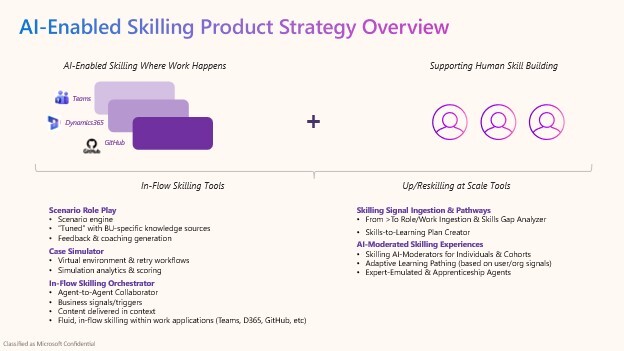
Pantoja stressed that effective upskilling and reskilling at scale depend heavily on upstream work that many organizations have not fully addressed. This includes clearly defined “from-to” skill transitions, robust skills taxonomies, and alignment across workforce planning, HR business partners, and business leaders. Without this foundation, even the most advanced AI learning tools cannot deliver meaningful outcomes.
He also highlighted several persistent and emerging challenges. Traditional issues like content fragmentation and discoverability remain, but the real problem is relevance—delivering the right learning at the right moment. At the same time, new concerns around trust, transparency, and data usage are becoming critical, as employees increasingly question how AI systems work and whether they can rely on them.
The presentation underscored the need to rethink learning content itself. Pantoja argued that traditional formats (such as SCORM-based content) are poorly suited for AI-driven environments. Instead, content must be modular, metadata-rich, and easily consumable by AI systems. He described a shift toward “atomic” content elements and dynamic assembly of learning experiences, enabled by AI.
Throughout the talk, he emphasized that this transformation requires coordinated effort across HR, business functions, and technology teams. Talent development can no longer operate in isolation; it must be tightly integrated with workforce planning, data systems, and business workflows. He also encouraged organizations to adopt an experimental mindset—making decisions quickly, revisiting them often, and recognizing how rapidly AI capabilities are evolving.


AMY SCHULTZ GROUP DISCUSSION ON AI FOR THE ENTERPRISE
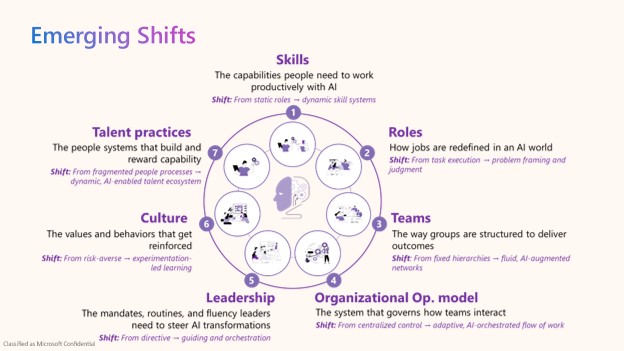
Amy Schultz facilitated a structured set of three small-group discussions focused on how organizations can move from “AI access” to “AI advantage,” emphasizing practical learning from what is actually working in enterprise AI transformation. She framed the conversations around three core themes—capability building, reinvention of work, and accountability—while encouraging participants to surface what is working, where they are stuck, what they are scaling, and what they are stopping.
In the first discussion on capability, upskilling, and reskilling, participants shared that most organizations were still in early stages, focused more on building awareness and basic capability rather than fully reimagining workforce transitions. Several organizations described assessing employee AI capability and creating segmented learning paths, while others emphasized broad-based upskilling—ensuring all employees could use AI to improve everyday productivity. At the same time, there was recognition that deeper reskilling for role transitions was less mature and harder to execute, particularly because it requires rethinking work itself, not just training individuals. A recurring tension emerged between top-down strategic initiatives and bottom-up adoption, with many organizations now trying to connect these efforts through more practical, role-based use cases. Participants also highlighted the importance of transparency, noting that employees respond better when organizations openly acknowledge uncertainty and involve them in shaping how AI will affect their work.
The second discussion focused on reinvention—whether organizations were truly redesigning work or simply digitizing existing processes. Participants shared examples of selectively redesigning functions rather than attempting enterprise-wide transformation, often starting with specific roles or teams. In some cases, work was deconstructed and reassembled, with routine tasks automated and roles elevated to more strategic, consultative work. However, many noted that most organizations are still balancing innovation with iteration, improving existing processes while gradually exploring more fundamental redesign. A key insight was that AI is beginning to challenge traditional role structures, prompting a shift toward more fluid definitions of work. At the same time, participants stressed the importance of preserving human elements—such as relationships and judgment—even as automation increases. There was also caution that AI can enable organizations to do more of the wrong things faster, reinforcing the need to anchor efforts in clear problem statements rather than simply applying technology because it is available.
The third discussion addressed accountability, governance, and performance. Participants highlighted that accountability for AI is often unclear or diffused, reflecting the broader “messiness” of transformation. There was growing recognition that organizations must balance empowerment with guardrails, ensuring responsible use of AI without slowing innovation. A key challenge discussed was measuring impact—many organizations are experimenting with ways to quantify efficiency and performance gains from AI but have not yet established consistent or reliable metrics. The importance of linking data across systems (such as HR, CRM, and operational data) was reinforced as a way to demonstrate real business outcomes. Participants also reiterated the need to focus AI efforts on meaningful problems, warning against the tendency to analyze data simply because it is available rather than because it drives value.
Across all three discussions, a consistent theme emerged: AI transformation is inherently complex and evolving, requiring organizations to experiment, learn quickly, and collaborate across silos. Success depends not only on technology, but on aligning skills, redesigning work, and creating the right governance and cultural conditions to sustain change.
JENNY DEARBORN ON HOW HR AND CAREERS MUST CHANGE
Guest Jenny Dearborn, CHRO, author & Researcher, gave a presentation centered on a fundamental shift in how the talent and HR function creates value—moving from reporting data to generating actionable business insight. She began by sharing a formative experience early in her career, when senior leaders challenged her to prove that learning programs drove real business outcomes, not just high satisfaction scores. That moment shaped her core philosophy: talent development must be tightly aligned to metrics that matter to the business. Over time, her work evolved from connecting learning data to business systems (such as CRM and ERP) to a broader realization that data alone was insufficient—what differentiated high-performing organizations was their ability to translate data into insight and action.

A central theme of her research was that while organizations were “swimming in data,” most struggled to interpret it meaningfully. She explained that the most effective CHROs distinguished themselves by integrating workforce data with business data and using it to tell a story that informed decisions and anticipated future challenges. In contrast, many HR functions presented data as an endpoint rather than the beginning of a strategic conversation. This gap, she argued, explained why HR often felt underleveraged despite being more critical than ever in a complex, rapidly changing environment.

Dearborn also explored the macro forces reshaping work, including demographic shifts, accelerating technological change (especially AI), and increasing global uncertainty. She highlighted how aging populations and declining birth rates were creating workforce scarcity and longer careers at the same time that technology was rapidly changing the nature of work. Leaders, she said, are often paralyzed by uncertainty and lack the insight needed to act. She positioned HR as uniquely responsible for translating these external forces into workforce implications and actionable business strategies.

Another key insight from her research was that CEO expectations of HR leaders had evolved. She noted that many CEOs were increasingly favoring business leaders with strong analytical and operational backgrounds over traditional HR specialists. This reflected a perception gap in which HR was still often seen as administrative rather than strategic. She emphasized that the most successful CHROs overcame this by building strong one-on-one relationships with the CEO and demonstrating clear business impact. Alignment between CEO expectations and the CHRO role was rare but critical, as misalignment often led to frustration or turnover.

Dearborn further explained that the future of careers and organizations would look very different. She described how longer lifespans and rapid skill obsolescence were shifting careers away from linear progression toward continuous cycles of learning, working, and reinvention. Organizations were becoming flatter, making lateral movement more important than upward promotion. She also stressed the growing importance of foundational human skills—such as critical thinking, creativity, and collaboration—alongside the emerging need for employees to manage and orchestrate AI tools as part of their work.

She concluded with a cautionary analogy, describing how companies like AT&T had once accurately predicted the future but failed to operationalize it.

The lesson she argued is that understanding trends was not enough—organizations needed to act on what they knew. For HR, this meant moving beyond reporting into shaping how work was done, how people and technology interacted, and how organizations adapted to change. She ultimately positioned HR as having the potential to be the most important function in driving transformation—if it could fully embrace a business-first, insight-driven mindset.
TALENT REVIEW PANEL
Marla Debbault of Borg Warner, Katherine MacNaughton of Manulife, and Raul Castenda Silva of Trane Technologies participated in a panel on Reimagining the Telent Review/Development Process. The panel, driven almost entirely by question from the Board members, explored how organizations are rethinking talent review processes in response to changing business needs, with each panelist representing a different stage of transformation. BorgWarner (8 years into a new approach), Manulife (just planning a transformation), and Trane Technologies (piloting a new approach this year) each described distinct approaches, but a common shift emerged: talent review was moving away from static, rating-driven exercises toward more dynamic, future-focused, and action-oriented processes.
At a foundational level, the panelists described different definitions of talent review. Katherine MacNaughton explained that at Manulife, talent review functioned as an enterprise-wide calibration of leadership capability and pipeline, focused on identifying who to accelerate, redeploy, and develop, while also supporting succession reporting requirements. Raul Castenda Silva described a dual approach at Trane Technologies—succession planning for senior roles and identification of high-potential talent across a broad population—beginning locally and building up to enterprise-level discussions with senior leadership. Marla Debbault emphasized BorgWarner’s decentralized, bottom-up process, where talent identification started at the site level and rolled up through the organization, reinforcing the idea that all talent belonged to the enterprise, not just individual business units.
All three panelists explained that they had rethought their approaches to address specific challenges. Debbault noted that BorgWarner had moved away from traditional nine-box debates, which had consumed time without driving meaningful outcomes, toward more future-focused conversations. She also highlighted the need to break down silos and enable cross-business unit movement. MacNaughton described Manulife’s introduction of a “talent to value” concept, which focused on identifying a small set of critical roles tied directly to future business value, while also seeking to streamline a lengthy and complex process. Castenda Silva emphasized that Trane’s changes were driven by a lack of credibility in succession planning outcomes and the need to align talent processes with future capability requirements, particularly in a rapidly evolving, technology-driven business environment.
A significant portion of the discussion focused on the evolution of ratings and assessments. The panel shared that while ratings had not been fully eliminated, their role had diminished. Debbault described a shift toward a simplified potential assessment based on agility, awareness, ability, and aspiration, with managers making judgment-based evaluations supported by calibration discussions. MacNaughton noted that Manulife continued to use structured processes but was working to modernize them and place greater emphasis on potential rather than past performance. Castenda Silva described a similar move away from traditional nine-box models, incorporating system-generated recommendations and simplified categories. Across the panel, there was agreement that the conversation had shifted from debating ratings to determining actionable outcomes for individuals—such as development, retention, or movement.
The panel also highlighted an important reframing of “potential.” Debbault and Castenda Silva both emphasized that potential should not be limited to future people leaders; technical experts and specialists could also represent critical talent. This led to the introduction of categories such as subject matter experts or retention-focused talent segments, ensuring that organizations could recognize and retain high-value contributors whose career paths differed from traditional leadership trajectories.
In response to questions from the Board, the panelists clarified that potential assessments were generally not tied directly to compensation, though they could influence retention tools such as equity awards. Instead, all three emphasized the power of transparency and dialogue. Castenda Silva noted that simply informing employees that they were considered top talent—and engaging them in career conversations—had significantly improved retention, sometimes more effectively than financial incentives.
Calibration and consistency emerged as ongoing challenges. The panel described multi-level calibration processes, cross-functional talent reviews, and even “draft-style” discussions to surface hidden talent and address gaps. Castenda Silva shared that rotating HR business partner responsibilities across functions helped reduce bias and broaden organizational understanding of talent. Debbault highlighted enterprise-level talent pools and targeted programs for early-career high-potential employees as mechanisms to increase visibility and mobility across the organization.
The discussion also surfaced the importance of redefining succession planning. Panelists noted that many organizations struggled with inflated or unrealistic succession pipelines and insufficient readiness. In response, they were introducing clearer definitions of readiness (e.g., “ready now” vs. “ready enough”), tracking actual movement and outcomes, and focusing on building real capability rather than simply populating plans. Some participants added that creating success profiles—defining the competencies, experiences, and performance expectations for critical roles—was essential to improving the quality and usability of succession data.
Ownership and accountability for development were also emphasized. The panel agreed that leaders—not HR—must own development plans, with HR providing frameworks, tools, and interventions. Regular reviews, often involving senior leadership or the CEO, were used to maintain accountability and ensure follow-through. However, execution remained a challenge, and panelists acknowledged the need for better ways to measure the quality of development conversations and outcomes.
Finally, the panel underscored several enduring principles. Debbault stressed the importance of maintaining a bottom-up approach to avoid overlooking talent. MacNaughton emphasized leader ownership and accountability as central to success. Castenda Silva highlighted the critical importance of executing development plans and ensuring that talent processes translated into real capability building. Across the discussion, the panel conveyed that while processes and tools would continue to evolve, the ultimate goal remained constant: to create a more transparent, dynamic, and business-aligned system for identifying, developing, and deploying talent.
WORLD CAFÉ
The end of the day was dedicated to letting members talk in small groups about the topics most interesting to them. They selected three topics for small group discussion: The New Demands of Leadership, AI Coaching, and Performance Management. In the report-outs, each group suggested a possible future meeting topic.
1. Leadership
Leadership keeps getting harder. There has been significant evolution in leadership expectations and development approaches in the context of AI and broader business transformation. Leadership development is increasingly being modernized to align with an AI-first environment, with organizations launching large-scale programs (e.g., year-long leader development journeys, immersive experiences, and speaker series) and experimenting with new tools such as virtual avatars to help managers practice feedback and empathy skills.
Though the group agreed that leaders must become more data-driven, business-oriented, and technologically fluent, they also asked if leaders need to become more human. Leadership effectiveness was also tied to the ability to navigate uncertainty, interpret external trends (such as AI and demographic shifts), and translate them into actionable strategies.
At the same time, organizations emphasized leader accountability for talent development, shifting ownership of development plans to leaders rather than HR. There is a growing focus on building leadership pipelines through succession planning, success profiles, and enterprise-level tracking of high-potential talent. Importantly, leadership itself was being redefined—moving from controlling work and careers to orchestrating talent, enabling mobility, and even managing AI agents rather than just people.
The question posed for a future discussion was: In the world of leadership development, what is net new?
2. AI Coaching
The group sees AI coaching as a rapidly expanding but still maturing capability. Organizations are experimenting with AI-driven coaching tools, including scenario-based role-play agents, expert-emulated agents trained on top performers, and virtual assistants embedded in workflows to provide real-time feedback and guidance. These tools were designed to scale coaching and learning in ways not previously possible.
There was strong interest in applying AI coaching to leadership development, with some organizations already piloting solutions that simulate conversations, provide coaching feedback, or guide decision-making. However, a key challenge identified was demonstrating ROI, particularly to justify continued investment in AI-enabled HR technologies.
Participants also raised important concerns around trust, transparency, and governance. As AI coaching tools proliferate, employees increasingly want to understand how these systems work, what data they use, and how reliable they are. Additionally, organizations are grappling with how to manage large numbers of internally created AI agents and ensure consistency, quality, and compliance.
Overall, AI coaching was seen as highly promising, particularly for scaling development and embedding learning into the flow of work, but still in an experimental phase requiring stronger measurement, governance, and integration.
The question posed for future discussion was: Can we find best practices for making the decisions on where and how to use AI coaches, for keeping managers at the heart of the process, and for showing ROI?
3. Performance Management
The group discussing performance management saw it as an area in need of modernization. Traditional approaches—especially ratings-based systems—were criticized for being backward-looking, administrative, and not effective in driving future performance or development.
Members said that their organizations are beginning to shift toward more forward-looking, potential-based, and experience-focused models, often separating performance evaluation from talent review and emphasizing development, skills, and future capability rather than past outcomes. At the same time, for most performance management remains tightly linked to compensation processes, including merit increases, bonuses, and promotions, which continued to create tension and complexity.
AI is starting to play a role in this transformation by streamlining administrative tasks and enabling more efficient processes. However, the group emphasized that the real opportunity was not efficiency alone, but improving the leader and employee experience—making performance conversations more meaningful, continuous, and development-focused.
Despite these changes, they acknowledged that most performance management systems remain complex, fragmented, and difficult for employees to navigate, with multiple tools and processes in place. The direction of travel was clear: toward simpler, more integrated systems that better support growth, feedback, and alignment with business strategy.
The question posed for future discussion was: How can we move away from discussions of performance management and instead talk about how to drive high performance? It was suggested that this could be the topic for a joint meeting with the Total Rewards Board.
At the conclusion of the discussion, the group suggested that the May meeting, scheduled to focus on skills-based talent, be broadened to a discussion of strategic workforce planning in an era of skills-based talent.

This meeting explored how talent and learning leaders are redefining careers, skills, and organizational models in the face of rapid, AI-driven change. The session focused on how to embed learning into the flow of work and evolve talent structures to enable agility, resilience, and sustained performance.
Key Topics Included:
- How the concept of a “career” is changing—and what that means for talent, learning, and workforce strategy.
- Embedding continuous learning into everyday work to keep pace with accelerating change and AI adoption.
- How talent and learning functions are restructuring to support future-ready organizations through data, technology, and new operating models.