

Interested in participating? Contact our team to discuss eligibility.
If you are an i4cp member, please log in to access the registration/meeting details.
Meeting Details
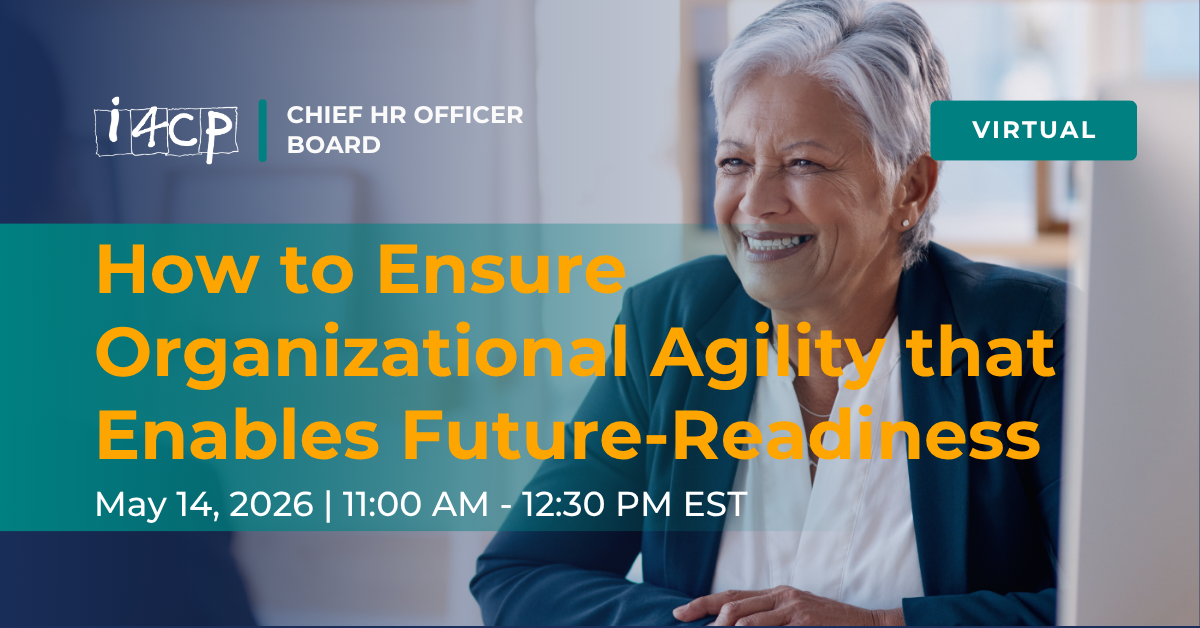
The i4cp CHRO Board met on May 14 for a session that was equal parts reflection and new.
Executive Summary
- Scottsdale reflections: CHROs are navigating stacked transformations, growing AI accountability, and a widening need to redesign work, rewards, and job architecture.
- New agility research: Future readiness comes less from structural moves like spans and layers and more from repeatable agility routines embedded through HR systems.
- Amplitude spotlight: A company-wide AI hackathon showed how fast experimentation can turn employee ideas into production-ready tools and a formal People AI roadmap.
- Coming up: Members should prepare for the June cross-board AI readiness session and the November in-person CHRO Board meeting at Toyota North America.
Looking Back to Move Forward: Reflections on Scottsdale
The session opened with a look back at the March in-person CHRO Board meeting in Scottsdale, AZ — and the energy was immediate. Board members were candid about what resonated most and where the conversation needs to go next.
- Transformation overload is real. One member captured the mood perfectly: "We're not dealing with a transformation — it's stacked transformations happening concurrently." CHROs are being asked to orchestrate simultaneous change under serious resource constraints. It's not sequential anymore.
- AI ownership is shifting to HR. Members noted a clear market shift toward CHROs owning AI strategy from an org design perspective — not just partnering with tech. The example of Ana White (Chief People Officer at Lumen who was our guest at our March meeting) who now also has "AI enablement" in her title sparked a rich discussion about why this makes sense, given that culture resistance (not technology) is the top barrier to AI adoption. And, even without this new title, why the CHRO needs to assert themselves in their enterprise AI governance and strategy.
- The board-level AI confidence gap. Skip Spriggs highlighted the disconnect between board expectations around AI measurement and where CHROs actually sit in that conversation.
- Work redesign skills are underdeveloped. One attendee raised a concern that clearly resonated: HR teams are strong on operating models and org structures, but not in discrete work redesign; deconstructing and reconstituting roles in the age of AI. John Boudreau built on this, advocating for HR to shift from delivering redesigned jobs to co-designing the future of work alongside business leaders.
- Compensation and job architecture need a rethink. Multiple members flagged the need to realign rewards as work is deconstructed. On person called job architecture "the Great Unsaid" — the infrastructure everything hangs on — and predicted it's going to get "messy for a while" as companies experiment with gig-style, SWAT-team models.
- The value of being in the room. There was unanimous sentiment shared by those who were unable to attend the March in-person Board meeting that they regretted not being part of the rich dialogue and insights shared in that meeting and missing out on the valuable time with their peers. One attendee of both the in-person meeting and this week’s virtual CHRO Board call summed it up warmly: "Sometimes it's just extremely validating to know our peers are going through the same things."
New Research: Agility Is What Enables Future Readiness
Kevin Martin then shared highlights from i4cp's latest study, , Designed for Disruption: The Agility Routines that Enable Future Readiness conducted in partnership with Professor Christopher Worley of USC's Marshall School of Business. The research introduces a new index combining Worley's four-factor agility model with i4cp's market performance index to identify four enterprise agility archetypes.
Four key findings stood out:
- Agility enables future readiness. The architype “Agile Pacesetters” — organizations in the upper quartile of both agility and market performance — are 16x more likely to be future ready than “Stagnant Underperformers”, 6x more than “Coasting Incumbents”, and 2x more than “Wildcards.”
- The Agility Illusion. Being highly agile doesn't guarantee results. Some organizations change constantly but without strategic discipline, leading to chaos, burnout, and exhaustion — not performance advantage.
- The Spans & Layers Fallacy. This finding generated the most discussion. The research found no statistical relationship between reducing layers or increasing spans and achieving agility. What matters instead are repeatable routines — the ability to anticipate, adapt, and act.
- HR is the engine. Agility gets hardwired through everyday people systems — learning, workforce planning, talent acquisition, performance management, and rewards. The research outlines specific practices across each HR function that correlate most strongly with high agility and high market performance.
The bottom line: Don't chase structure — build the routines. Treat anticipation as a leadership capability, use HR's levers to turn strategy into organizational muscle memory, and prepare the foundation with a change-ready culture.
Member Spotlight: Amplitude's Company-Wide AI Hackathon
KJ Johnson, CHRO of Amplitude, brought the session to life with a showcase of her company's recent AI Week — a company-wide hackathon where Amplitude essentially shut down normal operations and told every employee to go build something with AI.
What they did:
- The organization gave employees complete freedom to spin up any AI tool, build anything, and even break things. No restrictions, no committee approvals.
What they accomplished:
- 15–20 tools were deployed directly into production — not prototypes. Highlights from the HR team included an automated job description generator, an offer letter reviewer for international hires, a no-show detection agent for interviews, and a reimagined onboarding dashboard.
What's next:
- Amplitude now has a dedicated AI product manager within the People team running a formal roadmap — stack-ranking tools by deployment ease, system connections needed, and time to build.
- There was demand from the board for more exploration of this topic. Watch this space for potential follow-on sessions with the Amplitude team.
Coming up
- The next meeting on June 10, is an all-boards session, bringing together 100+ members from multiple i4cp boards to share functional perspectives on AI readiness, skills readiness, and culture readiness.
- And DO NOT MISS the in-person CHRO Board meeting this fall. It is November 3–4 at Toyota North America in Plano, TX, hosted by Kim Cockrell. You should have received a calendar invitation, so please RSVP there, and if you have any questions, contact ExecutiveBoards@i4cp.com.
Resources
- Report: Designed for Disruption: The Agility Routines that Enable Future Readiness
- Report: The Future-Ready Organization: Aligning Culture, Skills, and AI
This CHRO Board session examined the critical shift from resilience – how you respond to change once it occurs – to true organizational agility – sensing and responding to early signals to manage change proactively – as a prerequisite for future-readiness in an AI-accelerated world. Grounded in new research, the discussion will highlight how agile organizations anticipate change, adapt faster, and position themselves for long-term success.
Key Topics included:
- Distinguish resilience from agility, and why the difference is now mission-critical
- Explore how organizational agility enables future-readiness and supports AI-driven transformation
- Share how leaders are embedding agility at scale to anticipate disruption and create long-term advantage